What happens during a fly cast?
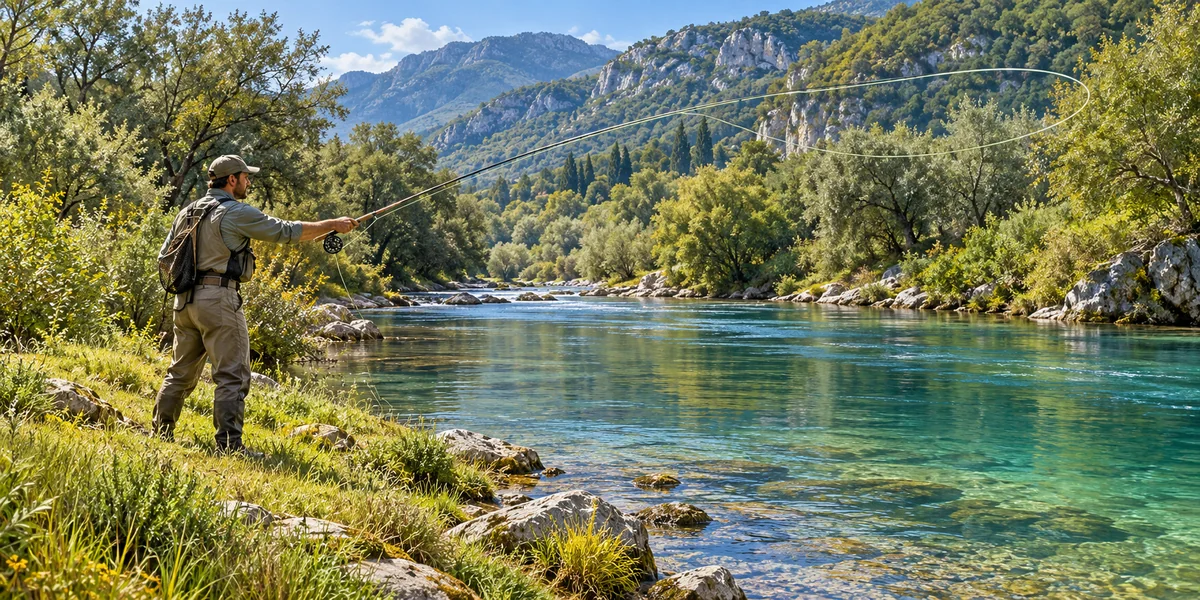
The rod bends under the line’s load and then transfers energy to it. A basic cast coordinates tip path, acceleration and the stop. More force does not automatically correct a poor path. Begin with a short length of line and a matched outfit before trying to reach the opposite bank.
Practise without a hook, using yarn at the end, in a safe open area. Check people, branches and overhead wires behind and above you; glasses protect your eyes. Written guidance explains the sequence, while an instructor can help correct your actual movement.
Why pause between the backcast and forward cast?
After the backcast, allow the line to unroll before starting forward. Starting too early disrupts the loop; waiting too long lets the line fall. Watch a short length of line unroll rather than counting a fixed number of seconds. The timing changes with line length and speed.
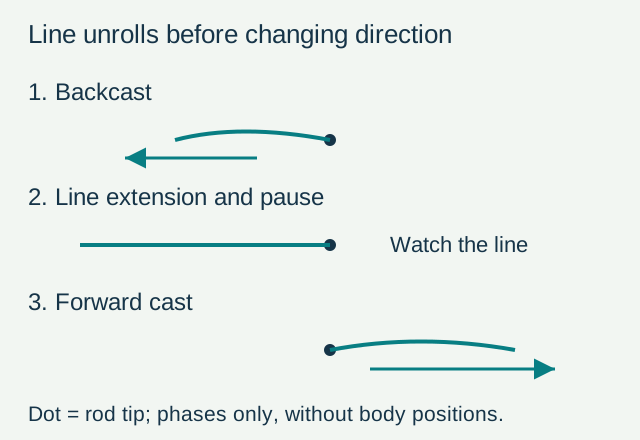
Guide the tip along as straight a path as possible. A large overhead arc makes it harder to unroll the line neatly. Finish with a positive stop rather than a hard jerk. If the line collapses in front, shorten it and check the tip path and the timing of the forward stroke again.
How does a roll cast begin?
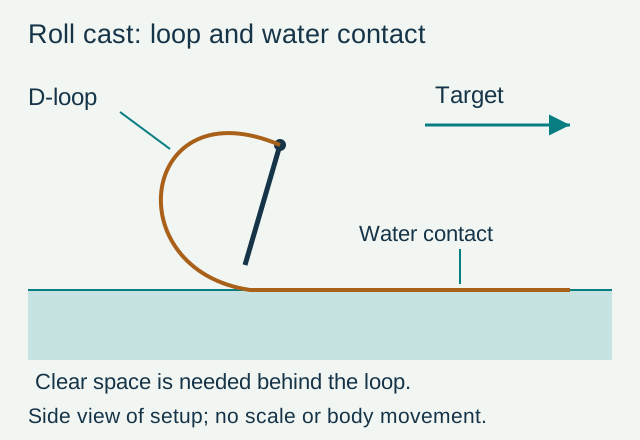
A roll cast uses line on the water in front and a D-loop behind the rod. It helps when a full backcast is restricted, but still needs room for that loop. It does not work without any clear space behind you.
- Start with a short length of line extended on the water in front and remove unnecessary slack.
- Slowly lift and draw back to form a D-loop behind the rod. The forward section stays in contact with the water as an anchor.
- Align the D-loop opposite the target and keep the line away from your body.
- Make a controlled forward stroke to a stop, then follow the extending and falling line with the rod tip.
Why is water practice important for a roll cast?
Practise the roll cast on water because the forward line needs that contact. It behaves differently on grass. The FFI instructions and Orvis lesson in the sources show the complete sequence. An instructor can help spot where the loop is lost if the forward stroke is difficult.
What should I check before casting farther?
Can you unroll the line without snagging, maintain safe clearance and place it along the intended route? If not, shorten the attempt. Then connect your cast to approaching the water and presenting a fly. Casting the weighted nymph in Euro nymphing needs separate treatment.