What is Euro nymphing?
Euro nymphing uses a long leader and its coloured sighter to follow a short subsurface drift. This introductory arrangement uses one weighted nymph. Check the permitted hook numbers and weighting for your chosen water before fishing.
Treat it as a step beyond understanding subsurface presentation. A long leader and short controlled route have different demands from introductory floating-line dry-fly fishing. Assess your existing outfit for its intended use rather than assuming every fly rod is equally suitable.
What does the sighter do, and how are the parts arranged?
A sighter is a contrasting leader section watched above the water, rather than a separate float carrying the rig. Our example runs from a longer upper leader through a sighter, small tippet ring and terminal tippet to one weighted nymph. The ring provides a separate tippet connection.
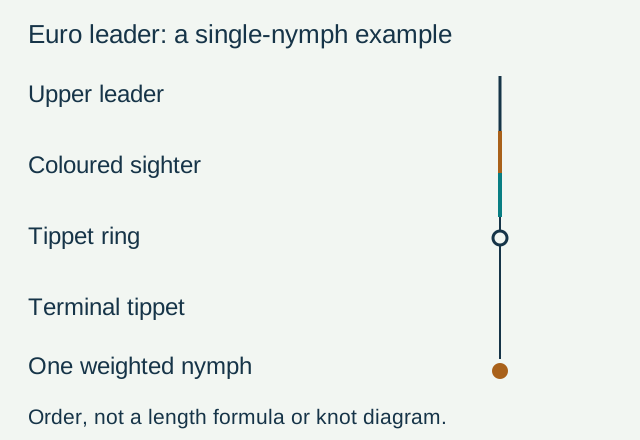
For a first attempt, choose a prepared leader intended for the method or follow a proven construction with matching materials. The diagram gives component order; check the connection instructions for the knot crossings. Inspect and pull-test each join before fishing.
Why does the cast differ from dry-fly casting?
The weighted nymph helps deliver this arrangement. Do not simply add a heavier fly to repeated long false casts learned with a conventional fly line. Start with a short controlled route, clear of other people, with eye protection. The separate Orvis casting lesson in the sources explains the method; this article does not replace demonstration and correction of movement.
How do I control a short drift?
- Choose an accessible current lane and a short drift you can follow from a safe position.
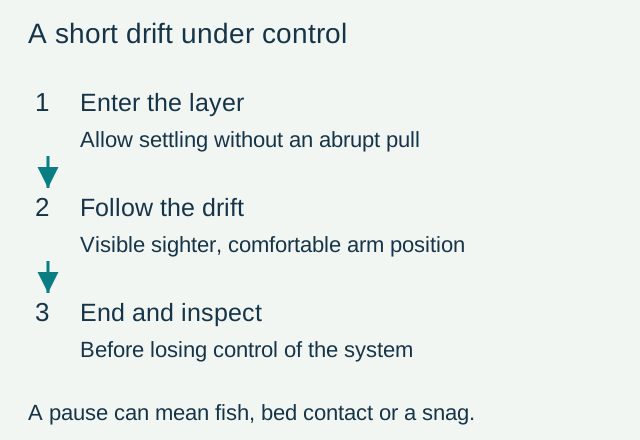
- After entry, allow the nymph to enter the intended layer before unnecessarily pulling it away. Judge weight and settling time against the actual current.
- Follow with the rod tip and visible sighter without abruptly accelerating the nymph. Avoid keeping the arm fully extended; adjust body position if comfortable control is lost.
- Watch for a pause or direction change. Fish, the bed or a snag can cause it; movement alone does not confirm a catch.
- End the drift while control remains and inspect the fly and terminal tippet.
What should I change when presentation is poor?
If you lose sight of the sighter or must reach with a fully extended arm, shorten the drift or change bank position. When the nymph snags, reconsider its route and how long you allow it to settle. Adjust tip height to depth and current, watching what changes on the next pass.
Return to reading trout water to choose a lane. Compare the method with the ordinary fly cast, and prepare your landing and release routine before fishing.