What should I look for before the first cast?
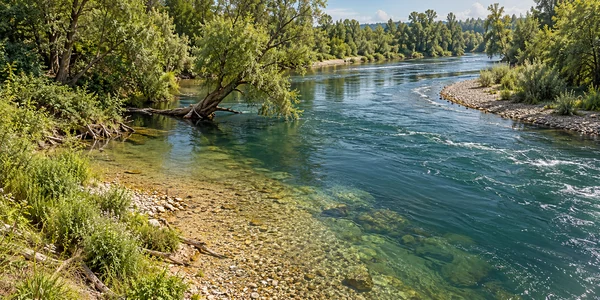
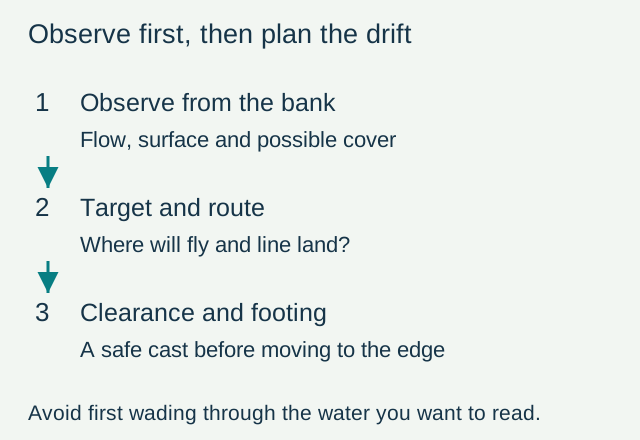
Before stepping to the edge, stop and watch the flow. Look for faster water carrying food beside a quieter place where a fish can hold with less effort. Watch the surface too: a repeated rise in one position is worth observing before the first cast.
Avoid immediately wading through water you have not examined. From the bank you may notice a seam, overhang or surface feeding before disturbing the area. If access is unsafe, choose another position instead of trying to reach every imagined holding spot.
Where do faster and slower currents meet?
Watch the boundary between the main flow and a quieter margin, shelter beside an obstruction and changes below a narrowing. Food and fly line do not travel at the same speed in every lane. Plan the fly’s route together with line placement rather than concentrating only on its landing point.
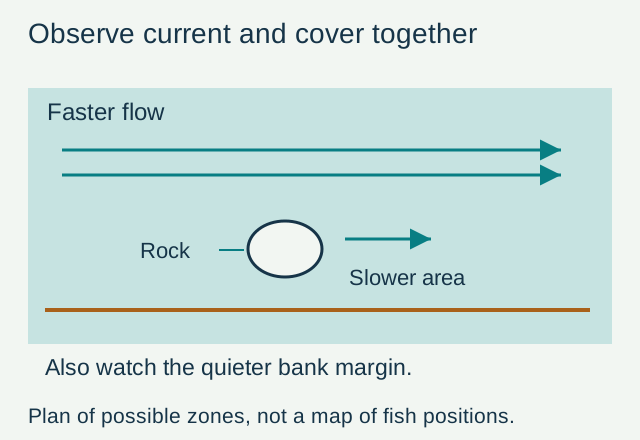
Check your observation over several passes of foam or leaves. The surface shows surface flow, not the exact speed and depth beneath it. One visible swirl cannot establish water depth or identify the riverbed material.
Which cover deserves attention?
Look at bank roots, undercuts, rocks and deeper areas. Cover is particularly worth examining beside a current that brings food. Choose one such place and plan the fly’s route instead of immediately casting at every rock.
Adapt your approach to what you observe. A lower outline and careful movement can reduce visibility. Trout in flowing water commonly face into the current, but that is not an instruction to approach in the same direction regardless of bank access, flow and safety.
How do I plan a first presentation?
- Choose one possible holding position and an observed flow lane.
- Check secure footing and clearance for the intended cast.
- Plan where the fly will land and where the line will lie, avoiding unnecessary passes over the target.
- Watch the complete drift. Change one aspect of the approach or presentation and compare the outcome.
How does observation inform fly choice?
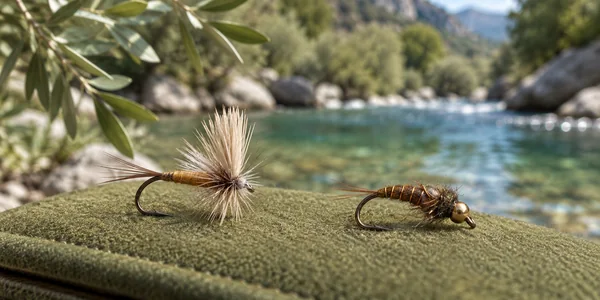
Repeated rises justify examining surface food and a dry-fly presentation. No visible rises does not itself prove that fish are not feeding. A separate Euro-nymphing guide introduces control of a short subsurface presentation.
Our general reading-water guide adds broader context. Identify species using the brown trout and grayling profiles, and check permitted methods and access with the Croatian fishery operator before fishing.