
Why does the float rise instead of sinking?
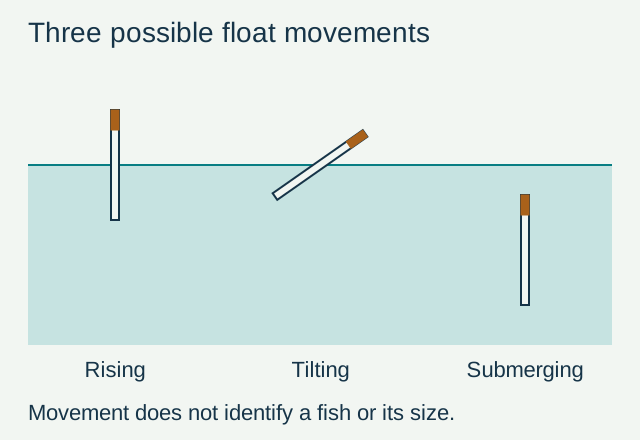
With the lift method, hookbait and anchor loading rest on the bed and the float is set a little deeper than the initial measured depth. Gentle line tension brings it into its working position. If a fish takes the bait and lifts the loading, the force holding the float down decreases, allowing it to rise, tilt or lie flat.
That is the principle in Angling Times’ original guide. It does not mean every tench produces an identical signal sequence. A fish moving away can also pull the float under. Line contact or a shifting anchor can produce movement without reliable confirmation of a hooked fish.
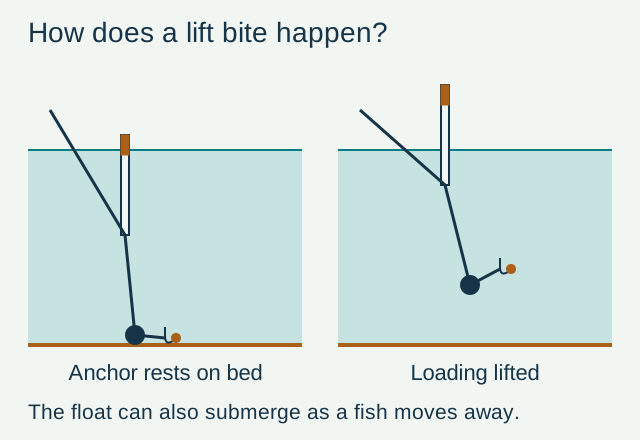
One simple lift arrangement
Here we describe a straight waggler attached only at its base with a suitable silicone rubber, with the main anchor loading close to the hook. That loading rests on the bed rather than hanging entirely free as in the initial ordinary-waggler loading check. This difference explains why the same loading routine cannot simply be copied without understanding its purpose.
Start with this simple bottom-rubber and anchor-shot arrangement. More elaborate lift rigs use extra rings or stops; leave those until later. First learn how to set the float and what happens when the anchor loading lifts off the bed.
Choose and prepare the swim
Choose accessible, calmer water where the float is visible and you can land a fish cleanly. Aim for a presentation you can understand: the anchor must stay in place and the hookbait must not be buried or hidden in thick weed. Measure depth first and check a few nearby points without clearing vegetation or reshaping the bed.
Loading can sink into very soft silt. Strong drift can shift it so that the float loses a stable starting position. Address those conditions through swim or presentation choice rather than repeatedly adding weight until control is lost.
Establish the working position
- Check connections and line condition, and prepare the landing net before starting.
- Set the rig slightly deeper than the measured reference and lower or cast it carefully onto the chosen point.
- Allow the anchor loading to settle on the bed. Put the rod on stable rests within reach.
- Gently recover excess line until the float reaches a clear working position. Do not drag the loading away while doing this.
- Observe that starting position and recheck if the anchor moves or the tackle returns tangled.
Respond to the signal
Keep the rod within reach and watch for the float rising, lying flat or going under. Respond with a controlled lift of the rod. If it only trembles briefly and returns to its starting position, keep watching instead of striking hard at every touch.
After a missed bite, check that the bait remains on the hook and restore the starting float position. Use the tench profile to identify a catch, and prepare your net and tools with the landing and release guide.