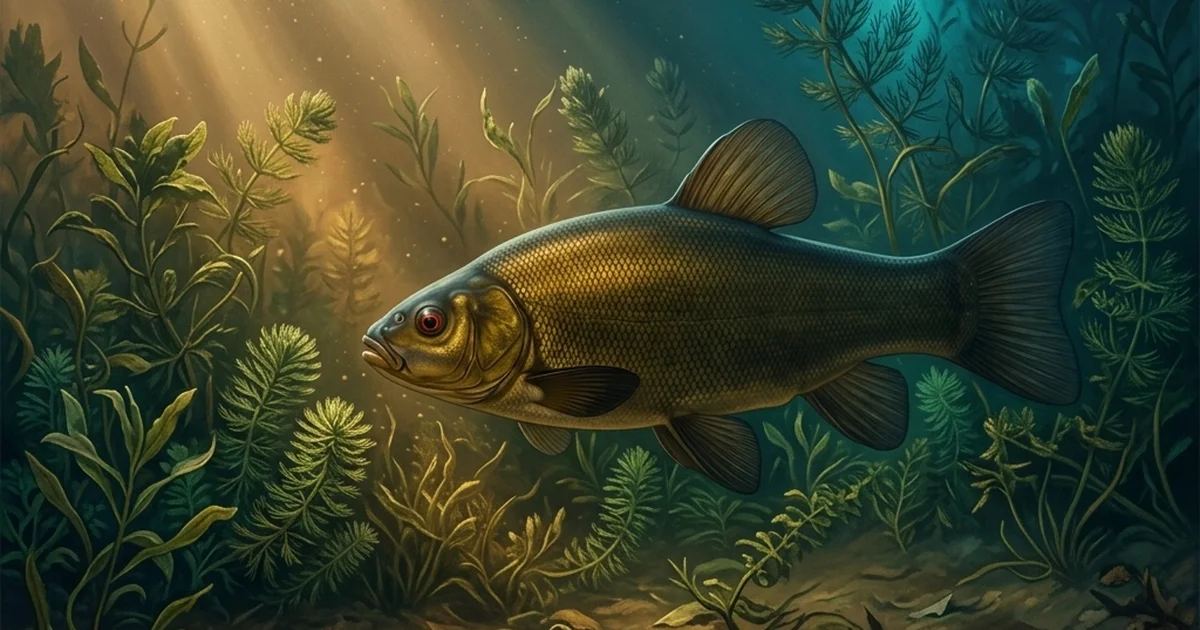
Most freshwater fish die when dissolved oxygen drops below 3 milligrams per liter. Brown trout starts gasping for air at five. Perch panics below four. Tench (Tinca tinca) in the same conditions slowly turns, finds the muddiest part of the shore and carries on as if nothing happened. Below one milligram of oxygen, where other fish count minutes, tench survives for hours and days. Physiologists have spent decades trying to understand how.
Blood that grabs oxygen
The first answer lies in hemoglobin. Eddy (1974, Journal of Experimental Biology) measured blood gases in tench under well-aerated and oxygen-deficient conditions and discovered that tench hemoglobin has an extremely high oxygen affinity. In other words, it binds oxygen even when the water holds so little that other salmonids or cyprinids cannot saturate their red cells at all.
Wells et al. (1989, Journal of Comparative Physiology B) extended this work and showed that the affinity curve is not static. Under prolonged hypoxia, tench regulates ATP levels in its red cells, shifting the curve even further in favor of oxygen binding. The fish literally rebuilds its blood in real time to extract every last O₂ molecule.
Forget oxygen, drop to idle
The second trick is brutally simple: spend less. Lomholt and Johansen (1979, Journal of Experimental Biology) measured oxygen consumption in tench under normal and hypoxic conditions. Under normal oxygen, tench consumes about 32.7 ml O₂ per kilogram body mass per hour. Under acute hypoxia, consumption drops to 10.8, less than a third. The fish essentially idles its engine.
Johansson and Nilsson (2019, Conservation Physiology) showed that this ability improves with acclimation. Tench exposed to low oxygen for longer periods develop greater metabolic flexibility and better hypoxia tolerance. The more hardship, the more resistant they become.
Muddy anglers, not gleaming riffles
This physiology explains where tench actually lives. Not in fast, crystal-clear streams like salmonids. Tench prefers warm, shallow, densely overgrown waters with muddy bottoms: oxbow lakes, backwaters, swamps and slow canals. In those habitats, especially in summer when temperatures spike and decomposing organic matter burns through oxygen, conditions are lethal to most other fish. For tench, this is home.
In extreme cases, tench can overwinter half-buried in frozen mud with minimal activity and an extremely low metabolism. When the water warms in spring, it wakes up as if nothing had happened. Few other freshwater fish in Europe can do the same.
Ecology: a fish that reshapes the whole shoreline
Tench is not just an isolated oddity. It has a documented effect on the structure of its ecosystem, and it acts through snails. Brönmark and Weisner (1992, Ecology) ran a classic enclosure experiment in a shallow lake in southern Sweden, stocking cages with different tench densities. The results were surprising.
Tench dramatically reduced the biomass of snails and bivalves in its cages. Snails normally graze epiphytic algae and periphyton growing on macrophytes. Without snails, epiphytic algae exploded and shaded the underwater plants. In the tench cages, the growth of the dominant submerged plant Elodea canadensis was significantly reduced. One snail predator triggered a cascade that reached all the way down to the plants.
This is one of the most clearly documented examples of a benthic trophic cascade in freshwater ecosystems. Tench does not change only itself. It shapes the entire shoreline it lives in.
In Croatian waters
In Croatia, tench is widespread in lowland waters of the Black Sea drainage, from oxbow lakes in Posavina and Podravina to canals in Baranja and Slavonia. It likes slow flows, side arms and ponds with dense vegetation. The closed season runs from May 1 to June 30, and the minimum size is 25 cm.
Because tench is both resistant and sensitive to water quality, it is an interesting double indicator. Its presence in a low-oxygen oxbow lake tells you the habitat still has functional benthic life. Its disappearance from such a place, however, usually means the water is so polluted that even a hypoxia specialist has given up.
A fish that does not quit
Tench is an example of how evolution solves problems through specialization rather than retreat. While other fish flee bad waters, tench stayed and built the tools to live there better than anyone. Next time you catch one from a muddy oxbow in August, remember you are looking at a survival specialist that has rebuilt its blood, its muscles, and the entire shoreline around it to be exactly where it is.