
When does a slider help?
A deep fixed-float setting leaves a long length of tackle hanging beneath the float during casting. A slider can move closer to the lower loading. Once it lands, line runs through its attachment again until the stop checks it. Fishing depth can therefore exceed rod length without that whole length hanging below the tip during the cast.
A slider is most useful when a fixed float would leave too much tackle hanging below the rod tip. In shallower water where you can cast a fixed rig comfortably, keep the simpler arrangement.
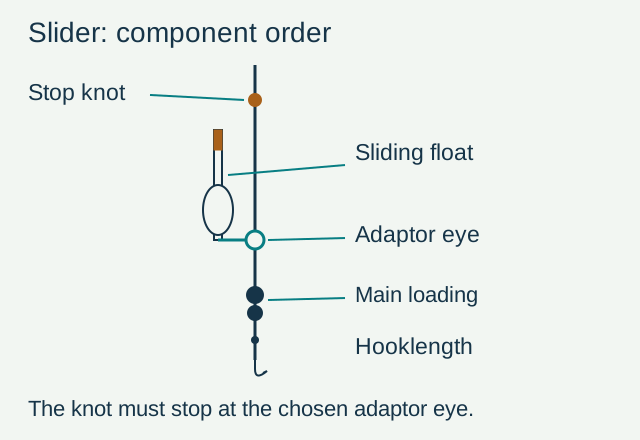
One defined slider arrangement
We follow the layout Drennan describes with Martin Bowler: a suitable bodied waggler, sliding base adaptor, a stop knot above it on the main line, then main loading and smaller droppers towards the hook. In this version the knot stops at the adaptor eye. Check that it cannot pass through the eye and that the adaptor runs freely on the line.
Keep the lower loading far enough away that it cannot strike the float body during casting. Choose a bodied slider with suitable capacity and an adaptor that lets the line run smoothly. Check both the clearance and line passage before the first cast.
A small stop knot has two jobs
The stop must hold its setting on the main line while passing cleanly through the rod guides during winding and casting. Check its size against the actual adaptor opening and guides, not merely its appearance on a table. Leave enough tag to inspect or tighten the connection.
NetKnots shows a stop made from a separate piece of line: form a loop beside the main line, take two or three turns through that loop around both lines, then tighten the ends in opposite directions. Practise the line crossings with their illustration. Then check that the knot grips your main line and passes through the rod guides.
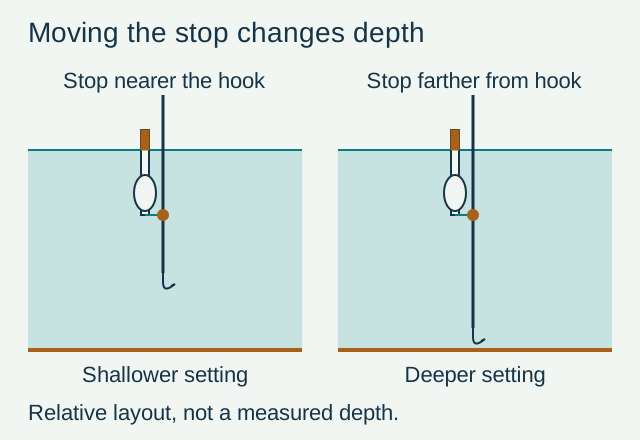
Set the fishing depth
- Position the stop at an initial depth estimate and check line passage and adaptor stopping.
- Measure the chosen spot with a plummet. A bank-side estimate is not a measurement.
- Increase the stop-to-hook distance to fish deeper; reduce it to fish shallower.
- Repeat the check and record the reference setting before fishing. After moving the knot, check that it holds the new position.
During casting, allow line to keep running as the lower loading sinks. In the described approach the bail arm remains open until the float stands up and settles; then close it and carefully recover excess slack. Stopping the line too early may prevent the rig reaching its set depth. Make the first attempts short and controlled.
When the float will not settle
Check three separate possibilities: trapped line, a stop passing through the adaptor, or lower loading reaching the bed before the expected settling process. Retrieve and inspect rather than pulling hard. Changing depth cannot clear a blocked connection, and adding shot cannot correct a knot that fails to stop the adaptor.