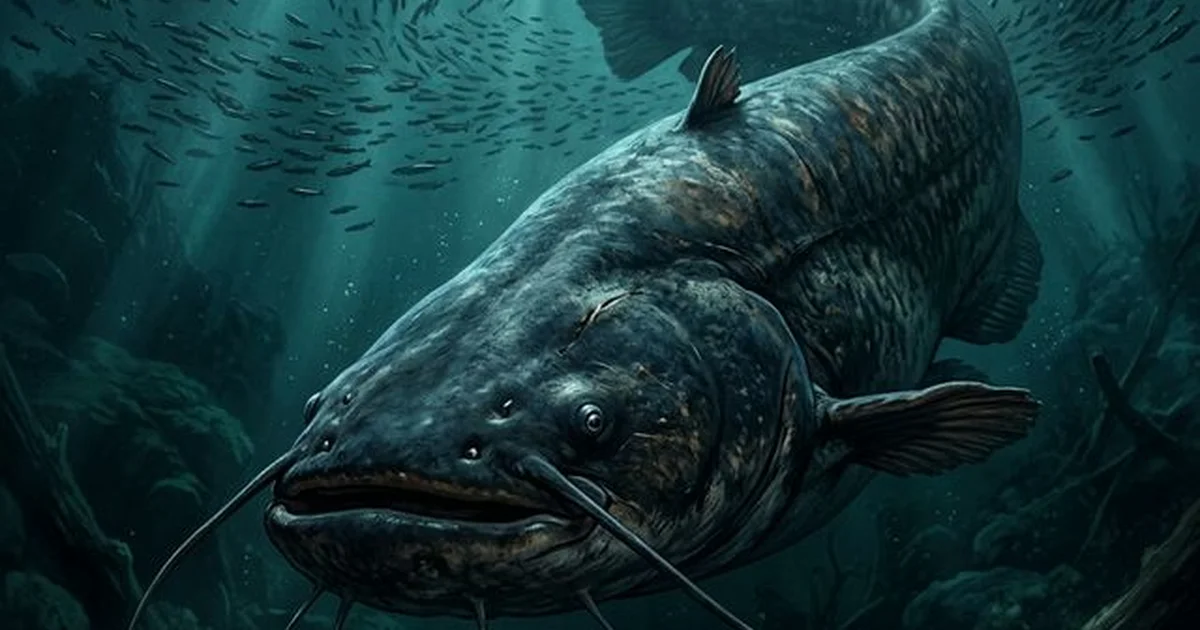
"That one should be taken out, it just eats all the fish anyway." If you have ever been on the Sava or Drava, you have heard this. Many anglers are convinced that large wels catfish, those over 50 kg, just drain the fish stock, that they can no longer reproduce, and that they should be removed from the water.
Let us look at what science has to say about that.
Can old catfish still reproduce?
Yes. Without exception.
Fish do not go through menopause. No scientific study has ever documented that wels catfish (Silurus glanis) stop being fertile with age. Quite the opposite: body size directly determines how many eggs a female will produce.
Research by Alp et al. on a catfish population in the Menzelet Reservoir showed that fecundity ranged from approximately 9,000 to 340,000 eggs per female, and that this number increases with body length and mass. The largest females, those over 150 cm, can produce up to half a million eggs per spawn.
In wels catfish, the male guards the nest after the female lays eggs. Larger males defend bigger territories and achieve higher hatching success.
A single large 80 kg female can produce more offspring than ten smaller females combined. And not just more offspring, but better quality ones. In many fish species, older and larger females produce bigger eggs with more nutrients, giving larvae better survival chances. In fisheries biology this is called the BOFFF concept: Big Old Fat Fecund Female Fish (Berkeley et al., 2004).
What do they actually eat?
Catfish are predators, that is true. But the claim that they "devour everything alive" is simplified to the point of being wrong.
According to the review by Copp et al. (2009), published in the prestigious journal Fish and Fisheries, catfish eat fish, crayfish, frogs, mussels and invertebrates. In the Danube delta, crayfish make up as much as 67% of the diet. The proportion of fish in the diet varies from 40 to 70% depending on habitat and prey availability.
A study by Vejrik et al. (2017), published in Scientific Reports, discovered something even more interesting: catfish have an extremely wide dietary niche, much wider than pike. Within a single population, some catfish are long-term generalists while others specialise in specific prey. This adaptability is precisely what makes them effective ecosystem regulators.
And here is the key detail: catfish prefer the most abundant prey species. In many European rivers, these are invasive species like the Prussian carp and round goby. Catfish thus effectively function as natural control of invasive species.
"But it is huge, surely it eats tonnes of fish"
Here the mathematics of metabolism tells a different story.
Metabolic rate per kilogram of body mass decreases with the size of the fish. A 100 kg catfish does not eat ten times more than a 10 kg one. It eats roughly 2-3 times more. While regulating a much larger portion of the ecosystem because it hunts bigger and more diverse prey.
Below 12 degrees, catfish feed less. Below 7 degrees, they stop eating entirely (Copp et al., 2009). That means they essentially skip winter. This is far from an animal that "devours everything alive, all year round".
What happens when you remove a big catfish?
When you remove a top predator from a river, things start to unravel. Ecologists call this a trophic cascade.
Without a large catfish, populations of mid-level predators (pike, zander, asp) surge because nothing controls them. They then overconsume small fish. Small fish populations begin to oscillate between rapid growth and collapse instead of maintaining balance.
A study published in PLoS ONE (2015) on a freshwater ecosystem documented this pattern. When the top predator was removed, both mesopredator release and prey release occurred simultaneously, changing the entire invertebrate community structure.
And then there is the genetic aspect. The largest, oldest catfish carry genes for fast growth, disease resistance and longevity. When you selectively remove them, only smaller, slower-growing specimens remain. The population becomes genetically weaker.
But in France, catfish are destroying rivers!
Yes, but the context is completely different, and this is where the biggest confusion arises.
In France, Spain and Italy, wels catfish is an invasive species. It was introduced in the 19th and 20th century for sport fishing. Local fish in those rivers never encountered this predator and lack defensive mechanisms. There, catfish genuinely can be problematic.
In the Danube basin, including Croatia, wels catfish is a native species. It has lived here since the Miocene. The entire fish community of the Sava, Drava and Danube evolved alongside it for millions of years. The ecosystem is calibrated for its presence.
When you read an alarming article about catfish destroying an ecosystem, check where the study comes from. If it is from Spain or France, it says nothing about the Sava near Slavonski Brod.
Catfish that hunt pigeons
Yes, this is real. Cucherousset et al. published the first scientific description in PLoS ONE in 2012: catfish in the River Tarn near the city of Albi in southern France deliberately beach themselves on gravel bars to grab feral pigeons drinking water. Out of 45 recorded attempts, 28% were successful.
But this has been documented exclusively in introduced populations under urban conditions in France. In the Danube basin, this behaviour has never been recorded. The viral videos are spectacular, but they have nothing to do with catfish behaviour in your river.
Catfish in Croatian waters
Wels catfish can grow to 2.7 metres and 130 kilograms, and live up to 70 years (Copp et al., 2009). In Croatia, they inhabit the entire Danube basin: the Sava, Drava, Danube and their tributaries. The closed season runs from April 16 to June 15, with a minimum keeping size of 60 cm.
Historical records mention catfish over two metres in the Sava in the 19th century. Current populations are smaller, mainly due to overfishing and river regulation. The Danube basin is one of the last places with genetically diverse, wild catfish populations.
Next time you catch a big catfish
Think for a moment. That fish may be 30 or 40 years old. It has survived decades of changes in the river. It produces more offspring than a dozen smaller specimens combined. It regulates other species populations in a way that maintains the health of the entire river. And it prefers to eat invasive species that bother you more than they bother it.
A big catfish is not your river's problem. It is far more likely to be part of the solution.