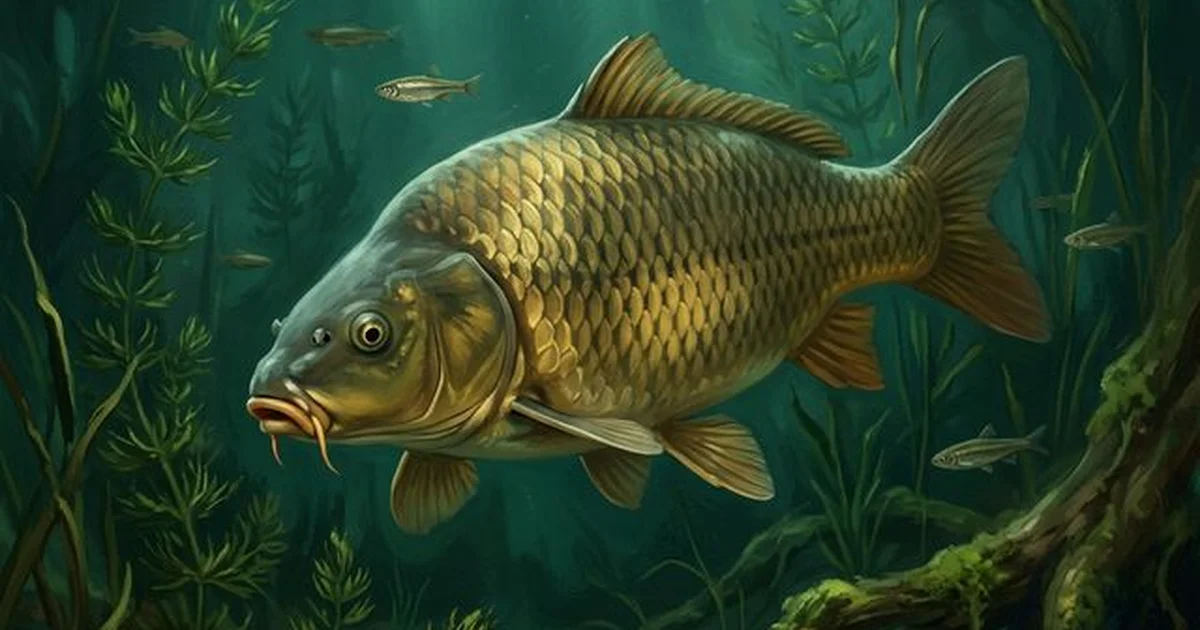
"Carp are dumb, they eat anything you throw at them." You have heard it. Maybe you have said it yourself. Most anglers treat carp as a fish that just roots around the bottom and swallows whatever it finds. And then they wonder why, after the first catch at the same spot, they can never catch one again.
The answer is simple: because the carp remembers the hook.
One hook is enough
Research by Loven Wallerius and colleagues (2020), published in Transactions of the American Fisheries Society, tested 120 juvenile carp under controlled conditions. The results were clear: a carp that had been hooked just once reduced its vulnerability by 57 to 74% within hours.
But that is not all. Carp that only watched another carp struggle on a hook, without being hooked themselves, reduced their vulnerability by 54 to 57%. Carp learn from the experience of others.
How long does this memory last? Czapla and colleagues (2023), in Fisheries Research, tracked hook memory over months. Privately learned avoidance persisted for up to 7 months. Socially learned avoidance, from watching others, faded after about 6 months.
Carp do not forget. They remember, learn, and adapt.
9,000 taste buds. And not just in the mouth.
When carp search for food, they do not rely on eyesight alone. Their entire body is covered in taste buds, from lips and barbels to fins and belly. Research by Gomahr, Palzenberger, and Kotrschal (1992), published in Environmental Biology of Fishes, mapped taste bud density in cyprinids. In the gular (throat) area, density reaches up to 300 taste buds per square millimetre. On the pectoral fins, up to 150.
Carp literally taste food with their fins before taking it into their mouths. Before you have even felt a bite, the carp has already assessed whether your bait is food or not.
Kasumyan and Doving documented the chemical sensitivity of carp taste: amino acids like cysteine, proline, and glutamic acid strongly attract carp, while tryptophan, arginine, and threonine repel them. Every bait you cast into the water is literally evaluated by its chemical composition before a carp swallows it.
A food-sorting factory
What happens inside a carp's mouth is an engineering marvel. Sibbing (1988), in a landmark study published in Environmental Biology of Fishes, identified 9 distinct feeding movements: particulate intake, gulping, rinsing, spitting, selective retention of food, transport, crushing, grinding, and deglutition.
Carp have no teeth in their jaws. Instead, deep in the throat they have pharyngeal teeth that crush food against a bony pad in the skull. Sibbing (1982) documented that these teeth have varied profiles, adapted for processing diverse food, from mussels to insect larvae.
But the most impressive part is the sorting. On the roof of the mouth, carp have a palatal organ densely packed with taste buds. Callan and Sanderson (2003), in the Journal of Experimental Biology, filmed the inside of a carp's mouth with high-speed cameras and discovered that carp use crossflow filtration, the same principle used in industrial filters. Food is concentrated and retained while sand and silt are expelled through the gill openings.
Carp do not swallow everything they find. They sort, filter, taste, and only then decide.
"They just root around on the bottom"
This is one of the most common myths. Yes, carp spend time on the bottom. But when food is not available there, they completely change strategy.
Feeding niche research has shown that when benthic food is unavailable, carp move to the mid-water column and spend up to 85% of their time feeding on zooplankton. Diet analysis in some lakes shows: zooplankton 36%, phytoplankton 31%, macrophytes 15%, detritus 15%.
Carp are not tied to the bottom. They are flexible omnivores that adapt to whatever is available.
Wild carp and scaled carp are not the same fish
Most anglers in Croatia catch scaled, mirror, or pond carp. Few know that these are all domesticated variants of a wild fish that once looked completely different.
The wild carp (Cyprinus carpio) has a torpedo-shaped body, is fully covered in scales, and is golden-yellow in colour. Balon (1995), in a review published in Aquaculture, documented how the Romans were the first to farm Danube carp over 2,000 years ago. Cistercian monks expanded pond farming across Europe by the 13th century, and Catholic fasting rules (fish permitted, meat forbidden) drove enormous demand.
The result? Two thousand years of selective breeding created a fish with a deeper body, faster growth, and in some cases, no scales at all.
Why do mirror carp have missing scales?
Casas and colleagues (2013), in a study published in PLoS ONE, uncovered the genetics behind scale loss. Two genes are responsible: the S locus and the N locus. The S gene is actually a variant of fgfr1a1 (fibroblast growth factor receptor 1). A mutation in this gene, either a 310 base-pair deletion or a single amino acid substitution, causes reduced scale production.
The combinations are straightforward: SS produces full scales, ss produces the mirror pattern, and adding the N allele creates the linear form. Interestingly, the NN combination is lethal, embryos with two N alleles do not survive.
Klefoth, Pieterek, and Arlinghaus (2013), in Fisheries Management and Ecology, showed that mirror carp behave differently from wild carp: they are bolder, eat faster, and are easier to catch. Domestication did not just change appearance, it changed personality.
Carp in Croatian waters
Piria, Tomljanovič, Treer, and colleagues (2016), in a paper published in Aquaculture International, provided a historical overview of carp in Croatia. Carp is native to the Danube basin. It has lived in the Sava, Drava, and Danube since the ecosystem existed. It was translocated into the Adriatic basin, where it is considered a non-native species.
But here is the problem: pure wild carp has virtually disappeared. Decades of stocking with farmed carp and crossbreeding with domestic variants has led to genetic mixing. Today it is practically impossible to distinguish a pure wild carp from a hybridized one in Croatian rivers through genetic analysis alone.
The closed season for carp in Croatia runs from 15 April to 15 June, and the minimum size is 40 cm.
The ecological shadow
Carp are not harmless. Weber and Brown (2009), in a review published in Reviews in Fisheries Science, analysed 37 controlled studies on the impact of carp on ecosystems. The conclusions were unambiguous: carp increase turbidity, boost phytoplankton, mobilise nutrients from sediment, reduce macroinvertebrates, and destroy aquatic vegetation.
The mechanism is simple: while feeding on the bottom, carp disturb the top 20 cm of sediment. This releases phosphorus and other nutrients into the water column, driving algal growth. In one study, after carp removal from a lake, turbidity decreased by 94%.
This is particularly important for shallow lakes and backwaters. Carp can trigger a so-called phase shift, flipping an ecosystem from a clear-water state to a permanently turbid state. In Australia and North America, where carp are invasive, this is an enormous ecological problem. In the Danube basin, where carp are native, the ecosystem evolved alongside them and these effects are part of the natural balance.
What this means for anglers
Carp are not a dumb fish that roots around on the bottom. They are:
- Smart: They learn to avoid hooks after a single catch. They learn by watching others. They remember for months.
- Sophisticated: They sort food in their mouths through 9 movements, taste with their fins, and filter using an industrial principle.
- Adaptable: They change feeding strategy depending on available food, from the bottom to the mid-water column.
- Diverse: Five variants in our waters, from the torpedo-shaped wild carp to the deep-bodied pond carp, each with different behaviour.
Next time a carp "is not biting," know that the problem is not the fish. It has simply learned.