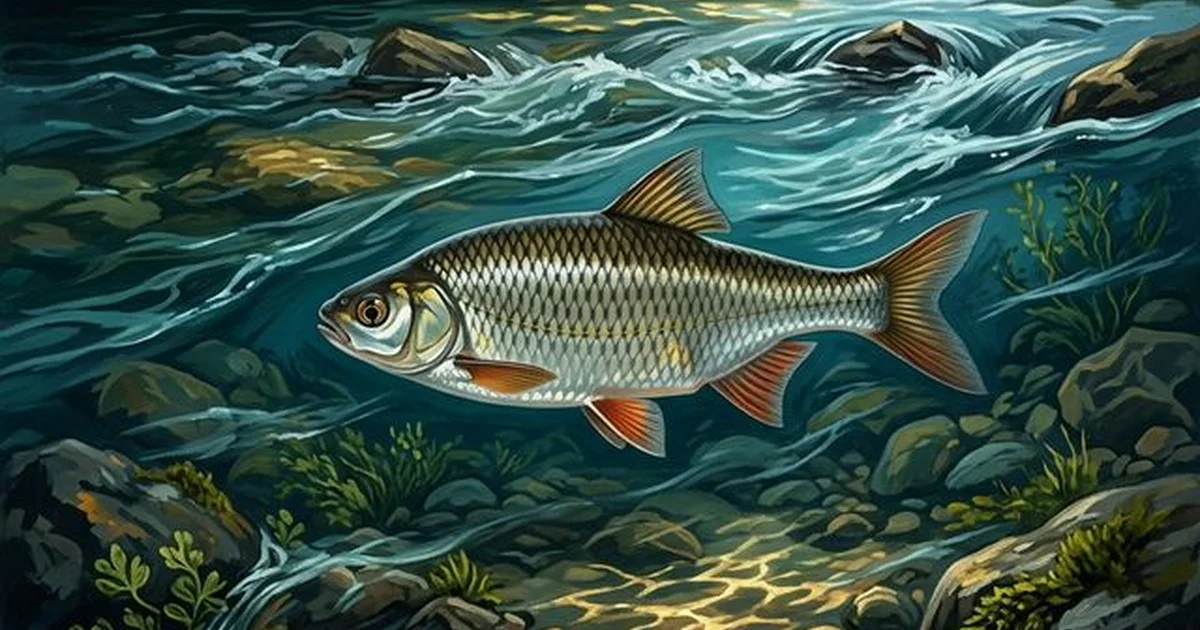
If you have ever fished on the Sava, Drava or Danube, you have almost certainly caught a cactus roach. Silver, medium-sized, nothing spectacular. Most anglers toss it back without a second glance, or throw it on the grill if it is big enough. But this unassuming fish has a story worth telling.
Not what the label says
On your fishing licence, the cactus roach is listed as Rutilus pigus virgo. But that classification is outdated. Since 2008, thanks to molecular research by Ketmaier and colleagues published in Molecular Phylogenetics and Evolution, the Danube roach is officially a separate species: Rutilus virgo.
Its Italian relative (Rutilus pigus) lives in the Po river basin and is genetically distinct enough to be considered a different species. They were long grouped together, but DNA analysis showed a clear split between Danube and Italian populations.
This is not just a taxonomic footnote. When two populations are treated as one species, conservation resources are shared. When they are recognised as separate, each gets its own status and its own threat assessment.
Endangered in Germany. Barely surviving in the Czech Republic.
According to the German Red List (Rote Liste, 2023), the cactus roach is classified as category 2: strongly endangered (stark gefährdet). In Bavaria, the only German state where it lives, the population declined sharply due to dams and river regulation.
The situation is serious enough that the Bavarian State Office for the Environment (LfU) launched a restocking programme in the Isar River in 2020. By the end of 2024, nearly 55,000 captive-bred specimens were released into the Isar, in cooperation with the fishing club Die Isarfischer and supported by the WWA Munich. The goal is to establish a self-sustaining population.
In the Czech Republic, the story is even more dramatic. The cactus roach was declared extinct there. The last confirmed record dated from 1954. Then, 62 years later, in January 2016, a single specimen was caught by rod and line on the River Dyje near the town of Břeclav. The discovery was published in the journal Folia Zoologica.
One fish, after six decades. That is how dire some populations have become.
And in Croatia?
In Croatia, the cactus roach is still a common fish. It lives in all major rivers of the Danube basin: the Sava (where it is most abundant), the Drava, the Danube, the Kupa, the Una, the Dobra and the Korana. It has a closed season from April 15 to May 31 and a minimum keeping size of 20 cm.
But "common" does not mean "safe". The cactus roach is a specialist of fast, clean water with rocky or gravelly bottoms. River regulation, dam construction and pollution reduce exactly that type of habitat. Our free-flowing stretches of the Sava and Drava are becoming increasingly important as refuges for species like the cactus roach.
Why it matters for the river
The cactus roach is not just "another white fish". It has a specific role in the river ecosystem.
It feeds on the bottom and in the mid-water column, eating aquatic insect larvae (caddisflies, mayflies, chironomids), small crustaceans, molluscs, as well as plant material and algae. Its trophic level is 3.4 according to FishBase data, meaning its diet is predominantly animal-based.
At the same time, the cactus roach is an important prey species for all major predators in our rivers: pike, zander, catfish and asp. This places it in the middle of the food chain, as a link connecting invertebrates to top predators.
But perhaps its most important role is one you cannot see at first glance. As a specialist of fast, clean water, the cactus roach is a river health indicator. Where it disappears and the Prussian carp increases, the river is degrading. The presence of the cactus roach means the river still has good flow, clean gravel for spawning and enough oxygen.
On the plate: a little effort, good flavour
The cactus roach is not among the finest eating fish, but it is not bad either. Like most cyprinids, it has Y-shaped intramuscular bones that make eating tricky. The traditional solution in Slavonia and Podravina is simple: scoring.
Make deep parallel cuts every 3-5 millimetres through the flesh before frying. Hot oil softens the small bones, and the fish becomes crispy and edible in its entirety. Another option is fish paprikash, where long cooking takes care of the bones.
The cactus roach is no carp or zander, but for a freshly caught river fish, fried with a little salt, paprika and lemon, it does the job nicely.
A species that deserves more attention
The cactus roach is protected under the EU Habitats Directive (Natura 2000), recorded across more than 50 protected sites throughout Europe, and listed in the Bern Convention. In Germany, there are active captive breeding and restocking programmes trying to save its population. In the Czech Republic, it nearly vanished entirely.
And in Croatia, we catch it, fry it, and rarely give it a second thought. Maybe it is time we started.