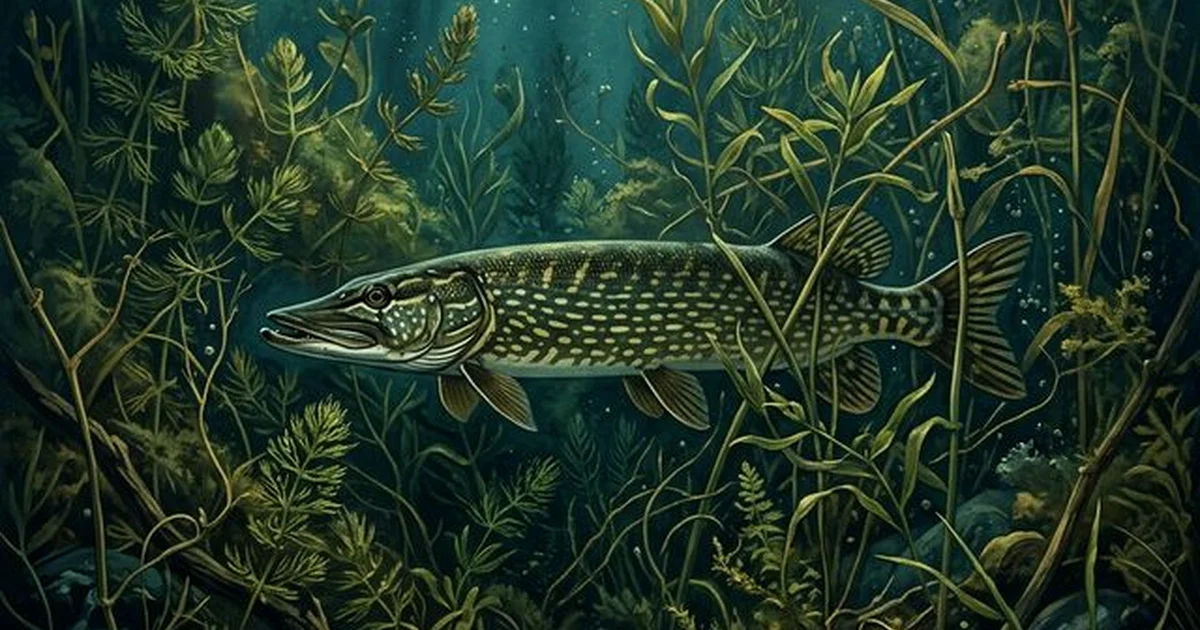
Late March. Pike closed season has just a few days left. While you wait, something important is happening in the shallow reed beds and flooded margins of our rivers. Pike (Esox lucius) are spawning, and they need very little for it: water at 6-8 degrees Celsius and peace.
What is happening underwater right now
Pike are among the first freshwater fish to spawn each year. Males have been at the spawning sites for weeks already. They arrived first, claimed shallow vegetated zones, and are waiting for females. Once eggs are laid, incubation takes 10-14 days depending on temperature. At 8 degrees, development is three times slower than at 16 degrees, but survival rates are nearly identical: between 70 and 76% (Realis-Doyelle et al., 2022).
That is why the closed season runs from February 1 to March 31. To give pike the time to finish spawning undisturbed.
What comes after spawning
As soon as spawning ends, pike enter a phase every angler knows well: post-spawn feeding. Starved after weeks of reproduction, they become extremely aggressive. They stay in shallow water, strike at anything that moves, and react to lures faster than at any other time of year.
This window lasts several weeks, typically through April while the water is between 8 and 15 degrees. Large specimens are still in accessible, shallow water. Later, as the water warms, they retreat to deeper areas.
Why temperature controls everything
But why does temperature play such a big role? The answer lies in something that applies to all freshwater fish, not just pike.
Fish are ectothermic organisms. They have no internal thermostat like we do. Water temperature literally determines the speed of every chemical reaction in their body, from digestion to muscle power.
In biology, this relationship is measured by the Q10 coefficient. For freshwater fish, the average Q10 is 2.36, according to research by Clarke and Johnston (1999) published in the Journal of Animal Ecology. In practice, this means that for every 10-degree rise in temperature, a fish's metabolic rate roughly doubles.
The consequences are real: in warm water, fish digest faster, burn energy faster and need more food. In cold water, everything slows down, digestion takes up to three times longer, and a fish can survive for days without a meal.
Pike and its optimal range
Pike can tolerate temperatures from nearly 0 degrees up to about 29 degrees Celsius (Casselman, 1978). But surviving and being active are not the same thing.
Pike are most active and feed most aggressively between 10 and 18 degrees. This is the zone where their metabolism produces enough energy for explosive ambush strikes, while not consuming too much oxygen. This is exactly the range we enter in late March and April.
An interesting detail: younger pike (up to about 2 kg) prefer slightly warmer water, around 19-21 degrees. But larger pike over 3 kg tend to stay at 10-13 degrees. Larger fish have a slower metabolic rate per kilogram of body mass, so warmer water costs them more energy than they can compensate for by feeding.
What summer brings
Above 21 degrees, pike start seeking cooler areas. They retreat to deeper parts of lakes or rivers, looking for spots where groundwater enters the channel or where tree shade keeps things cool.
The problem is not just heat. Warmer water holds less dissolved oxygen. Pike start spending more energy just on breathing, leaving less for hunting. Below 2 mg/L of dissolved oxygen, they practically stop feeding.
If the temperature exceeds 25 degrees and stays there for several days, feeding almost completely stops. Pike switch to energy-saving mode: holding in ambush positions but not striking, or hunting only in brief windows at dawn and dusk.
And in winter?
Below 4 degrees, pike activity drops dramatically. Below 2 degrees they barely move. But this is not true hibernation.
Research published in the Journal of Experimental Biology (2022) showed that fish in winter do not actively lower their metabolism the way some mammals do. Energy savings come from two factors: stopping activity (they simply hold still) and passive slowing of chemical reactions due to cold water (the Arrhenius effect). The body does not "shut down" voluntarily. Physics forces it to slow down.
Pike in Croatian waters
In Croatia, pike inhabit the entire Danube basin, including the Sava, Drava and their tributaries. They are also found in the waters of Istria, in Vrana Lake on the island of Cres, and in the Gacka River.
Approximately 22-23 tonnes of pike are caught in Croatia annually. Commercial fishing is permitted only on the Danube and the lower Sava. The minimum keeping size is 40 cm.
According to the IUCN, pike are globally classified as Least Concern (LC), but their population resilience is low. Population doubling time ranges from 4.5 to 14 years, which is another reason why the closed season matters.
Your spring temperature guide
The closed season ends on April 1. If you track water temperature (and you should), here is what to expect:
- 6-10 degrees (early April): post-spawn feeding in full swing, pike are in the shallows and aggressive
- 10-15 degrees (April/May): ideal period, pike actively hunt throughout the day
- 15-18 degrees (late May): still excellent, but larger specimens start retreating to deeper water
- Above 18 degrees: switch to early morning and evening sessions, especially for big pike
Water temperature is not just a number on a thermometer. For pike and all other fish, it is what a thermostat is to your home. Except fish cannot adjust it themselves. And right now, as the water warms from winter into spring temperatures, pike are preparing for the most active period of the year.