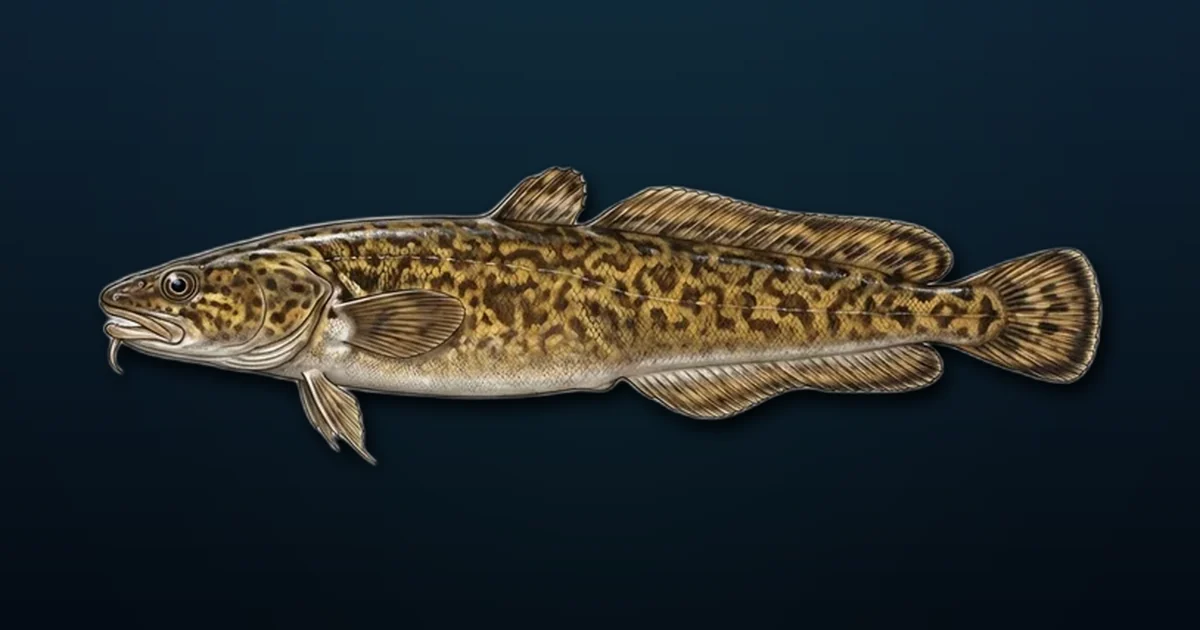
While most of our fish slow down in winter and all but stop feeding, one fish is only getting started. The burbot is the only freshwater relative of cod in our waters, and the only native fish that spawns in the dead of winter, often literally under the ice. Most anglers do not even know it exists.
A cod in the river
The burbot (Lota lota) is the only freshwater member of the cod family (Gadidae). It carries a single barbel on its chin, just like the marine cod, and an elongated, snake-like body covered in slime. It is neither a trout nor a catfish, but an evolutionary loner that brought the cod blueprint into the cold rivers of the northern hemisphere.
Spawning under the ice
Here the burbot breaks every rule. It spawns in midwinter, usually from December to March, at water temperatures of just 1 to 4 °C. The classic descriptions record its strange behaviour: a group of individuals weaves into a living, rolling ball on the bottom and releases and fertilises eggs that way (U.S. Fish & Wildlife Service, Burbot: The Singsong Gadoid). A single female can shed hundreds of thousands of tiny eggs that drift in the cold water.
A night hunter that hates light
The burbot is strongly nocturnal and light-sensitive. By day it hides under stones, roots and in the deeper, dark parts of the river, and it hunts after dark. That is why you rarely see it, even though in some waters it is more numerous than it seems. Its peak activity falls in the coldest part of the year, when other predators are sluggish.
A fish built for the cold
The burbot is a cold-water specialist. It works best near 0 to 4 °C, and in summer, when the water warms, it turns sluggish and withdraws into the coldest, deepest refuges. That is the mirror image of most of our fish: while carp and catfish thrive in summer, the burbot waits for winter.
A fish disappearing from Europe
The burbot was once widespread across the northern hemisphere, but in parts of its range it is in serious decline. In the United Kingdom it went extinct in the mid-20th century. A worldwide status review pointed to river regulation, barriers and pollution as the main causes of its disappearance (Stapanian et al., 2010, Fish and Fisheries). As a species of cold, clean, flowing water, the burbot is a good indicator of river health.
The burbot in Croatian waters
Here the burbot lives in the colder, deeper reaches of large rivers such as the Sava, Drava and Danube, and in some sinking rivers and lakes. It is rare and prized precisely because it is caught when almost no one else fishes, on cold winter nights. Before you go, check the closed season and minimum size in your water district, because it is locally sensitive and slow to recover.
Why the burbot is worth knowing
The burbot destroys the idea that winter is a dead season for fishing. While others pack away their gear, it spawns and hunts in ice-cold water. Catch one and you are holding a little cod that settled into our rivers from some ancient, cold world. That is strange enough to earn respect and a careful, informed approach.