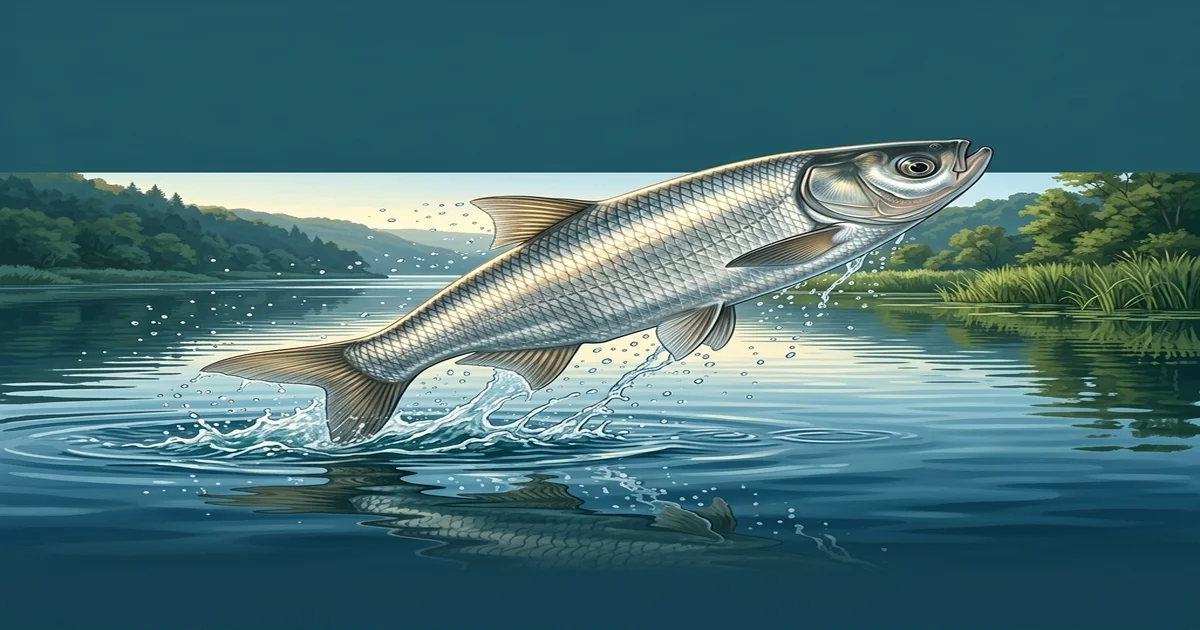
In Illinois there is footage of anglers cruising a small aluminum boat down a quiet river when the water suddenly explodes into a cloud of fish weighing more than 20 kilograms. They fly two meters above the hull, slam into the windshield, leave scales on the deck. This is not a horror film but a real response of the silver carp (Hypophthalmichthys molitrix) to the sound of a motor. And this reaction is neither random nor harmless. It is evolution's answer to a predator that does not exist where the fish now lives.
What exactly triggers the jump
Vetter et al. (2017, Management of Biological Invasions) ran the most detailed study to date on silver carp jumping in response to motorized watercraft. The experiment on the Illinois River near Havana tested 6-meter aluminum boats with 4-stroke motors of 100 or 150 HP at speeds of 16, 24, 32 and 40 km/h. The results were striking.
57.9 percent of boat passes triggered jumping by five or more fish. Jumping frequency was independent of speed or motor type. More than 90 percent of fish jumped after the boat had passed, and almost none directly astern (within 4 meters). Juvenile and adult fish of about 25 kg could rise as high as 3 meters above the water surface.
A sound the fish cannot ignore
In a follow-up experiment, Vetter et al. (2016, Proceedings of Meetings on Acoustics) played the recorded sound of a 100 HP motor through underwater speakers mounted on a slow-moving boat. Silver carp jumped in 100 percent of sound trials. This proved that a specific floating vessel is not needed as a trigger. The broadband sound in the 0.06 to 10 kHz range alone is enough.
Why that range? All Asian carp (Hypophthalmichthys) have a special Weberian apparatus, a series of small bones linking the swim bladder to the inner ear. This adaptation turns the fish body into a tiny hydrophone tuned to low-frequency sounds. In their native Asian rivers, this system helped them detect approaching large predators and traditional river craft. In North America, where the species is invasive, the same reflex now launches fish into anglers' faces.
A filter that eats the entire planktonic column
When not jumping, silver carp is doing something much more serious: filtering water. It has extremely fine gill rakers that efficiently retain particles larger than about 20 micrometers, including larger phytoplankton and most zooplankton. In a dense eutrophic lake, a single 10 kg fish can filter tens of cubic meters of water per day.
Because of this ability, silver carp has been used for decades in Chinese and European biomanipulation as a supposed tool to clear lakes of algae. The idea is simple: if the fish eats phytoplankton, removing phytoplankton biomass should clear the water. In practice, things are not that simple.
The paradox: a fish that amplifies algal blooms
Ke et al. (2021, Freshwater Biology) ran a long outdoor mesocosm experiment in which silver carp was stocked into eutrophic conditions and results were measured. The finding was the opposite of what was expected: silver carp stocking promoted phytoplankton growth, not through nutrient recycling as long believed, but through zooplankton suppression.
The mechanism is clear once you see it. Silver carp efficiently grazes large plankton, including big cladocerans like Daphnia that are the main natural grazers of phytoplankton. Remove the grazers, and phytoplankton, especially small cells smaller than 20 micrometers that silver carp cannot retain in its filter, loses its main predator. The result: an explosion of nanophytoplankton, often exactly the species that cause blooms and foul smells.
Radke and Kahl (2002, Aquatic Ecology) found the same pattern in a natural system, the Villerest reservoir in France. Silver carp at moderate densities did not improve water quality. Instead, it shifted the phytoplankton community toward smaller, harder-to-control species. The classical "solution" turned into a problem.
In Croatian waters
In Croatia both silver carp and bighead carp are used strictly as introduced species in carp ponds and some reservoirs. Like grass carp, they do not reproduce naturally in Croatian waters, because they need long rivers with continuous flow to develop their pelagic eggs. The closed season runs from April 1 to May 31, and the minimum size is 40 cm.
If one hits you in the face today while you cruise through Kopački Rit, the reason is a physiological reflex older than any motor. Sound means danger. And danger is escaped by jumping, not diving.
A spectacular fish, a murky solution
Silver carp is one of the most dramatic fish you can see in Europe, not because of its size or color but because of the moment it leaves the water. Yet the same fish shows how stubbornly ecology resists simple solutions. There is no magic fish that will clean a lake. There are only fish that change how a lake works, sometimes for the better, sometimes in entirely the wrong direction.