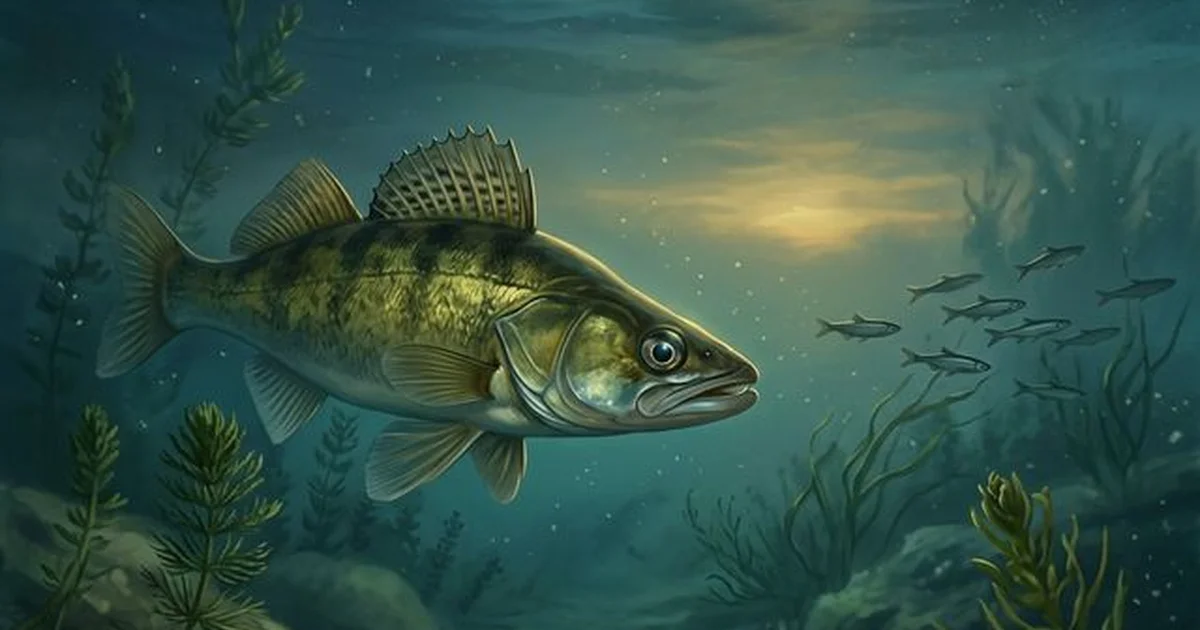
Ask any angler on the Drava or Sava when they fish for zander and you will get the same answer: in the evening, at dusk, when darkness falls. Everyone knows this. But few know why. The answer lies in a layer of tissue at the back of the eye that has turned the zander into the most sophisticated night hunter in our rivers.
An eye that amplifies light
Behind the retina of the zander's eye sits a reflective tissue layer called the tapetum lucidum. The same layer is found in cats, deer, and owls. In fish, it is exceptionally rare.
The tapetum works in a simple but remarkably effective way: every photon of light that passes through the retina without activating a photoreceptor bounces back and gets a second chance. The retina literally gets two attempts at every photon instead of one.
But that is not all. Zander also have disproportionately large eyes relative to their body. A study by Jokela-Määttä and colleagues (2019), published in the Journal of Fish Biology, compared the eyes of zander, pike, perch, and roach from two Finnish lakes. The results were clear: zander have at least twice the light sensitivity of pike of the same size. For a 50 cm fish, the zander's eye diameter is about 19 mm compared to 16 mm for pike. That sounds like a small difference, but the amount of light entering the eye scales with the square of the pupil diameter, so the zander's eye gathers roughly 40% more light from size alone, and the tapetum doubles that advantage further.
A retina built for darkness
Light sensitivity is not the only adaptation. The zander retina is rod-dominated, packed with photoreceptors specialized for low-light performance. Rods cannot distinguish color, but they are extremely sensitive to movement and contrast.
Zander are not completely color-blind, however. Research by Burkhardt and Hassin (1978), published in Vision Research, identified two types of cones in the zander retina: green-sensitive (peak absorption around 530 nm) and orange-sensitive (peak absorption around 605 nm). This means zander can distinguish certain colors, but far less effectively than roach or bream, which have a much denser network of cones.
For anglers, this has a practical implication: lure color matters less than its vibration and movement profile. In low-visibility conditions, zander primarily detect prey by movement, not color.
Murky water is not a problem. Murky water is an advantage.
Here is where it gets interesting for anglers. Most predators perform worse in turbid water. Zander perform better.
In clear lakes, pike is the dominant predator. Its ambush strategy depends on good visibility. But when water becomes turbid, whether from eutrophication, rain, or suspended particles, pike loses its advantage. Zander takes over.
Jokela-Määttä and colleagues documented this dynamic by comparing populations from a clear and a dark lake. In the dark, humic lake, zander eyes were further adapted, with higher rod density and an enhanced tapetum. Pike in the same lake showed no comparable adaptation.
This is known in ecology as competitive replacement: when water becomes turbid, zander displaces pike because of its sensory advantage. In many European lakes that have undergone eutrophication, zander populations have grown precisely at the expense of declining pike populations.
Movement through the day: telemetry reveals the pattern
A telemetry study by Zak and colleagues (2008), published in Hydrobiologia, tracked adult zander in a riverine environment using radio transmitters. The results showed a clear daily pattern:
- Daytime: deep water in the main channel
- Dusk: movement toward shallows
- Night: littoral zone, closest to the banks
Peak activity was at dusk, confirming what anglers have long known. But the study also revealed something surprising: nighttime positions in shallows were not always associated with hunting. Zander often moved toward the banks at night to rest, while intensive feeding occurred in the brief window of dusk and dawn.
Another telemetry study by Poulet and colleagues (2005) in Hydrobiologia confirmed the same pattern in a Mediterranean canal: maximum activity at dusk, minimum at night. Both sexes showed identical rhythms.
A seasonal hunter: temperature sets the rules
Zander are not equally active year-round. Research by Frisk and colleagues (2012), published in Aquaculture, found that adult zander have a broad thermal optimum between 10.4 and 26.9 °C, but with peak metabolic scope at 18.8 °C.
Interestingly, juvenile zander prefer warmer water. The optimal temperature for growth in young fish is 28 °C (Kestemont et al., 2003). When temperatures drop below 10 °C, activity decreases significantly, and below 5 °C zander feeds rarely and reluctantly.
For anglers this means: spring and autumn, when water is between 12 and 22 °C, are the most favorable periods. Summer can be too warm for peak feeding in adult fish, while winter is not hopeless but demands patience.
Diet: a small-fish specialist
Zander is an obligate piscivore, meaning adults feed almost exclusively on fish. But unlike catfish, which eat practically anything they catch, zander is selective.
A study by Dörner and colleagues (2007), published in Ecology of Freshwater Fish, analyzed the relationship between zander size and prey size. Zander have a relatively narrow gape compared to their body, so they prefer smaller, fusiform fish: bleak, roach, white bream, and juveniles of other species. This is a completely different niche from pike or catfish.
The transition to fish prey begins extremely early. At just 31 mm in length, zander start hunting fish (Specziár, 2005). In the first weeks they eat zooplankton, then switch to macroinvertebrates, then to fish. This rapid transition to piscivory is one reason why zander is such a successful predator.
Cannibalism: the dark side of young zander
One of the darkest traits of zander is a tendency toward cannibalism early in life. Research by Colchen and colleagues (2023), published in Aquaculture, showed that cannibalism in zander larvae begins as early as 14 to 17 days post-hatching, and between individuals of similar size.
But here is the surprise: cannibals proved to be significantly better hunters than non-cannibals. In feeding tests, cannibalistic larvae were more efficient at catching zebrafish (Danio rerio) in both predation and cannibalistic scenarios. Cannibalism is not just a sign of hunger, but an early indicator of superior hunting ability.
A father who guards the nest
Zander spawning reveals a completely different side of this fish. Males select the nest site, clean it of silt, and defend the territory. Nests are shallow depressions in sand or gravel, roughly 50 centimeters across, or are built among submerged tree roots.
Lappalainen and colleagues (2003) published a review of zander reproductive biology in Ecology of Freshwater Fish. Spawning begins when water temperature reaches 12 to 15 °C, usually in spring. Males attract females through complex courtship behavior, and egg-laying itself lasts 10 to 15 minutes.
Afterward, the male drives away the female and remains to guard the nest. He fans the eggs with his pectoral fins to ensure oxygen supply. During guarding, he becomes extremely aggressive. Żarski and colleagues (2019) in Aquaculture documented males attacking divers who approached nests.
Females choose males based on nest quality. In 77% of recorded spawning events, the female chose the larger male, who showed more consistent nest-cleaning efforts (Żarski et al., 2022).
Zander in Croatian waters
Zander is a native species in the Danube basin. In Croatia it lives in the Sava, Drava, Danube, and their tributaries. It can grow up to 130 cm and 10 kg, and live up to 20 years.
Unlike western Europe, where zander is often an introduced species, in our waters it has been present as long as the ecosystem itself. The entire fish community of the Sava and Drava evolved alongside it. Migrations of up to 250 km have been recorded, and populations show strong site fidelity.
The closed season for zander in Croatia runs from March 1 to May 31, with a minimum size limit of 40 cm.
What this means for anglers
The science of zander vision and behavior is not just academic curiosity. It has very concrete implications for fishing:
- Timing: Dusk and dawn are confirmed as peak activity. But not because zander starts hunting then, rather because that is the only time it has an advantage over its prey.
- Turbid water: After rain or high water levels, when other anglers give up, zander is actually more active. Turbidity is its domain.
- Lure color: Less important than you think. Vibration, movement profile, and lure size matter more because zander relies on rods and the lateral line when hunting, not on color-detecting cones.
- Temperature: Ideally between 12 and 22 °C. On hot summer days, zander retreats to depth and feeds less.
- Depth: During the day, look for it in deep water of the main channel. At dusk, follow it toward the shallows.
Zander is not a mystical hunter. Its strategy is completely logical once you understand how its eye works. It simply hunts when and where it has the greatest advantage, which is in darkness and turbidity, while the rest of the fish world sleeps.