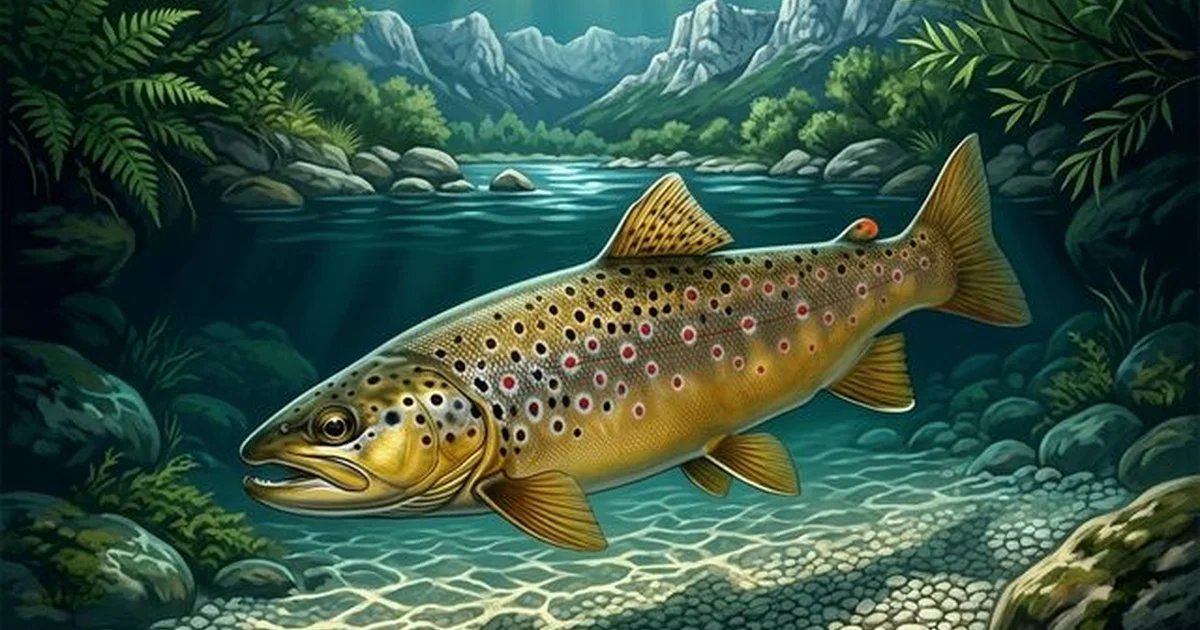
When a female brown trout (Salmo trutta fario) digs a shallow redd in the gravel of an upper mountain stream in late autumn, she does not choose the spot at random. She chooses it by smell. Most likely by the same smell she experienced a few years earlier, when she first swam through that stretch of river as a young fish. Scientists call this mechanism olfactory imprinting, and it is one of the most precise navigation systems in the entire freshwater world.
A river has a fingerprint
Every creek, every river, every tributary has its own chemical signature. Dissolved amino acids, minerals leached from bedrock, organic compounds from leaves, algae and microbes, all combine into a cocktail of molecules unlike any other waterway on the planet. For a trout, that chemical cocktail functions as a home address.
Keefer and Caudill (2014, Reviews in Fish Biology and Fisheries) synthesized decades of homing research in salmonids and concluded that olfactory navigation is the primary mechanism by which salmon and trout return to natal spawning grounds. Not the geomagnetic field, not a solar compass, not the stars. The smell of the river.
A window in the brain that opens only once
Imprinting does not happen at just any point in life. It happens during one specific developmental phase called the parr-smolt transformation, when the young fish transitions from early juvenile to subadult. During this short window, thyroid hormones surge in the blood and the fish brain essentially locks in the chemical profile of the water around it.
Dittman and Quinn (1996, Journal of Experimental Biology) showed that this thyroid hormone surge coincides with the critical period during which lasting olfactory memory forms. Outside this window, learning new odors essentially does not happen. The fish has one shot to remember home.
The experiment that proved it
The most influential experiment in this field was conducted by Arthur Hasler in the 1960s and 1970s. He exposed young salmonids to synthetic chemicals (morpholine and phenethyl alcohol) during the parr-smolt phase, then released them. When they returned as adults to spawn, the vast majority entered exactly those tributaries into which researchers had added the same synthetic scents. Accuracy was 92 to 96 percent. The fish did not fail even when the scent was laboratory-made.
That result changed how we understand spawning migrations. Imprinting is not an abstract instinct but a measurable neurochemical process. Brown trout literally remembers molecules.
A trout that never sees the sea
The classic story of olfactory imprinting is tied to anadromous species, Atlantic salmon and sea trout, which descend to the ocean and years later find their way back to the exact right stream. But the resident brown trout of European mountain rivers never goes to the sea. And yet it shows the same mechanism.
Nordeng (2006, Ecology of Freshwater Fish) ran a classic transplantation experiment between neighboring river systems with resident brown trout and Arctic charr. Fish moved to a neighboring stream would not stay. They returned to their original system, sometimes crossing several kilometers of unfamiliar terrain. Resident trout uses the same sensory system as its migratory cousin, just on a much smaller geographic scale.
Ecology: when home becomes a problem
Imprinting gives brown trout an unbeatable advantage in its native waters, but when humans relocate it to another continent, the same biology becomes an ecological problem. Budy and Gaeta (2017), in a chapter on brown trout as a global invader, described how this species, listed among the IUCN's 100 worst invasive species worldwide, has displaced native salmonids in North America, South Africa, Patagonia, Australia and New Zealand.
The mechanism is a mix of predation and direct competition. In New Zealand, introduced brown trout triggered a trophic cascade reaching all the way down to algae, as it suppressed native small fish that normally kept aquatic insect populations in check. Simon and Townsend (2003, Freshwater Biology) documented how introducing trout doubled periphyton biomass in streams that had run for millions of years without a large predator.
The same species, a prized jewel and bioindicator in one ecosystem, becomes a destructive invader in another. The only difference is geography.
In Croatian waters
In Croatia, brown trout is native to cold, well-shaded mountain streams of both the Black Sea and Adriatic drainages. The upper reaches of the Gacka, Lika, Kupa, Dobra, Mrežnica and upper Drava still hold healthy populations. The closed season runs from October 1 to February 28, and the minimum size is 25 cm in most waters. Individual water bodies have stricter local rules, so always check with the local fishing association before heading out.
Every brown trout you release is not just one fish. If it is a female, you have returned an entire generation of offspring that will come back to the same gravel in a few years. She knows exactly where to go.
A fish with an address
Brown trout is not just a beautiful, sensitive and culinarily prized fish. It is living proof that evolution can turn the smell of water into a form of memory. Every time you see a trout hovering over a specific rock along a streambank, consider that she may be standing on the exact spot where she hatched. And she did not get there by chance. She got there by smell.