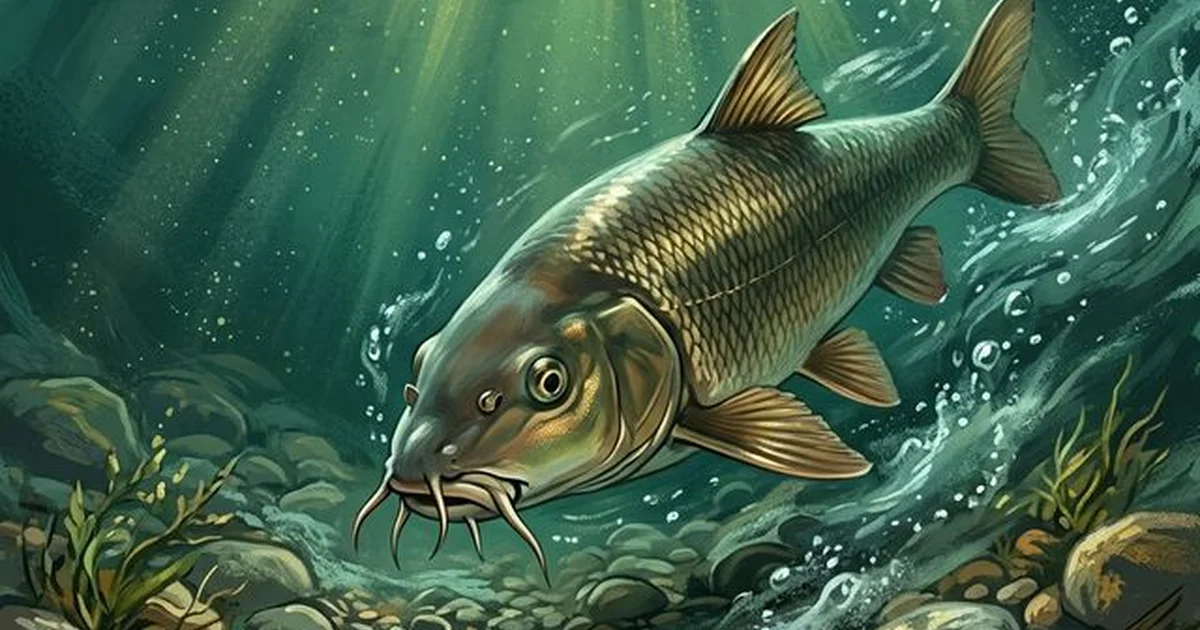
Barbel is a fish that anglers respect. Not because it is beautiful, not because it is tasty, but because on the hook it can humble you like no other freshwater fish of its size. Barbel (Barbus barbus) lives in fast, gravelly rivers and is built for fighting current. But what most anglers do not know is that this fish hides a dangerous secret in its roe.
Roe that poisons
Barbel is the only native freshwater fish in Croatia whose roe is toxic. The condition is so well-known it has its own name: "barbel cholera". Comelli, Ricco, and Cervellin (2018), in a review published in Acta Biomedica, documented the symptoms: massive diarrhoea, vomiting, and severe abdominal pain begin 2 to 4 hours after consumption and last 12 to 36 hours. In rare cases, bradycardia and hypovolaemic shock can occur.
What exactly causes the poisoning? Mancini and colleagues (2011), in a study published in Toxicon, analysed the chemical composition of the roe. They found 25 different fatty acids, mainly polyunsaturated (PUFAs), including arachidonic acid, DHA, and EPA. These fatty acids show haemolytic activity, destroying red blood cells, and cytotoxicity toward cell lines.
Interestingly, only unfertilized roe is toxic. Barbel flesh is completely safe to eat. But even small amounts of roe can trigger the full clinical picture of poisoning.
Barbels that taste the river
Barbel has four barbels: two on the snout and two at the mouth corners. These barbels are not decoration. They are chemical sensors covered in taste buds that allow barbel to "taste" the riverbed while searching for food.
Gomahr, Palzenberger, and Kotrschal (1992), in Environmental Biology of Fishes, showed that benthic cyprinids have exceptionally high taste bud density, up to 700 per square millimetre on fins. The barbels are only part of the system. The entire underside of the barbel's body functions as a chemical scanner that detects crustaceans, insect larvae, and molluscs hidden in gravel.
But barbel does not rely on taste alone. As a cyprinid, it possesses a Weberian apparatus, a series of four small bones connecting the swim bladder to the inner ear. This system turns the swim bladder into a sound amplifier and gives barbel exceptionally sensitive hearing, ideal for detecting vibrations in turbulent water.
Built for current
Barbel does not live in fast water by accident. Every part of its body is adapted for life in current.
The body is fusiform and flattened on the underside. Pectoral fins are set low and horizontal, functioning as miniature hydrofoils that press the fish against the riverbed. The tail fin has asymmetrical lobes: the lower one is rounded and shorter than the upper, producing downward force during swimming.
How strong is barbel really? Clough and colleagues (2004), in a technical report for the UK Environment Agency, tested barbel in an 8-metre flume tank. Rheophilic cyprinids like barbel achieve critical swimming speeds that significantly exceed those of trout. That is not a typo: barbel, a lowland river fish, can outsprint trout.
Romao and colleagues (2020), in Scientific Reports, confirmed that body length is the most important predictor of critical swimming speed. An adult barbel of 60-80 cm is a sports car of fast water.
The autumn feeding marathon
Every angler knows that autumn is barbel time. But why?
Baras (1995), in a study published in the Journal of Fish Biology, tracked daily activity patterns of barbel throughout the year. He discovered that activity rhythm changes with the season. In summer, barbel shows crepuscular activity, feeding at dawn and dusk. But in autumn, when temperature drops to 9 to 10 degrees, something unusual appears: a trimodal activity pattern with an additional feeding phase in the middle of the day.
Barbel in autumn shift to intensive feeding because they must accumulate energy reserves for winter. Britton and Pegg (2011), in a review published in Reviews in Fisheries Science, documented that barbel enters dormancy below 4 degrees, a state of minimal activity. Autumn is the last chance to eat.
But the myth that barbel "do not bite in winter" is not entirely true. Above 4-5 degrees, barbel can feed. Warmer winter days can bring activity, but the threshold is thermal, not calendrical.
"Barbel only feed on the bottom"
Barbel is primarily a benthic fish. Its mouth is underslung, its barbels designed for probing the substrate. But research shows it is not exclusively tied to the bottom.
De Santis, Gutmann Roberts, and Britton (2019), in Fisheries Research, used stable isotope analysis on barbel from 11 English rivers. The results were surprising: up to 71% of barbel in some rivers had significant dietary contributions from non-benthic food, mainly marine fishmeal baits used by anglers. This proportion increases with fish size.
Barbel eat what is available. On the bottom they seek amphipods (Gammarus), mayfly larvae (Ephemeroptera) and caddisfly larvae (Trichoptera), but they do not refuse food from other water layers.
Spawning: drama on the rapids
Barbel spawning is a spectacle. Popp, Pinter, Schwayer, and Hayes (2024), in Frontiers in Environmental Science, studied barbel in a Danube tributary near Vienna. Spawning begins when water temperature reaches 13.5 degrees, usually from May to July.
Females choose shallow rapids with clean gravel, at depths of 37 to 50 cm and current speeds of 40 to 100 cm/s. There they build depressions in the gravel similar to salmon redds. Gutmann Roberts and colleagues (2020), in River Research and Applications, measured that spawning barbel can move more than 97% of bed particles at their spawning site.
A single female lays 8,000 to 12,000 eggs per kilogram of body weight. Eggs are about 3 mm in diameter and swell by 18% in the first hour. Spawning is polyandrous, one female spawns with multiple males, and up to 130 males have been recorded at a single spawning site.
A traveller that returns
Barbel is a potamodromous fish, migrating within freshwater systems. And these migrations are not short.
Telemetry studies document annual movements of 16 to 68 km, with average daily displacements of 26 to 139 m. Home ranges in the Danube extend to 34.4 km. Spawning migrations exceed 20 km upstream.
A barbel population typically consists of a majority of sedentary individuals with home ranges under 1 km and a smaller number of highly mobile individuals that travel tens of kilometres. These mobile individuals are crucial for genetic connectivity between populations.
Danube barbel: the little sister from mountain streams
Croatian waters are home to another barbel species: Danube barbel (Barbus balcanicus). Kotlik and colleagues (2002), in Folia Zoologica, described it as a distinct species based on mitochondrial DNA analysis.
The differences are clear: Danube barbel grows to only 17.5 cm, while common barbel reaches 120 cm. Danube barbel lives in cold mountain streams at elevations of 300 to 1,000 m, while common barbel inhabits middle and lower courses of large rivers. Their habitats barely overlap.
Raguz and colleagues (2021), in Knowledge and Management of Aquatic Ecosystems, sampled 30 Danube barbel populations in Croatia. They identified 15 new haplotypes and three geographic regions: northern (Medvednica, Ivancica), eastern (Papuk, Krndija), and central (Banija, Petrova Gora). Croatian populations separated approximately 680,000 years ago during Pleistocene glaciations.
Danube barbel is a Natura 2000 species requiring monitoring in Croatia.
Barbel in Croatian waters
Barbel is native to the Danube basin. It lives in the Sava, Drava, Danube, and their tributaries. It can grow to 120 cm and 12 kg, and live 15 to 20 years.
The main threats are river channelization, flow regulation, dams blocking access to spawning sites, and siltation of gravel beds. The population doubles slowly, in 4.5 to 14 years, making barbel vulnerable to overfishing and habitat loss.
The minimum size for barbel in Croatia is 28 cm. There is no closed season.
What this means for anglers
- Autumn is peak, but not the only time. Barbel feed in all warm months. In summer, fish at dawn and dusk. In autumn, even midday works.
- Current is home. Look for them on rapids with gravel bottoms, at depths of 2 to 6 m. They spawn on shallows of 40 to 50 cm depth.
- Be ready for a fight. Barbel in current use their body as an anchor and their fins as hydrofoils. A 3 kg fish fights like a 6 kg one.
- Never eat the roe. The flesh is excellent, but the roe is toxic. Even small amounts cause severe poisoning.
- Release large specimens. The population recovers slowly. A large female is invaluable for spawning.
Barbel is not a glamorous fish. It has no bright colours or spectacular jumps. But when you hook one in a rapid at 4 metres depth and feel the first pull, you will understand why anglers call it the queen of the rapids.