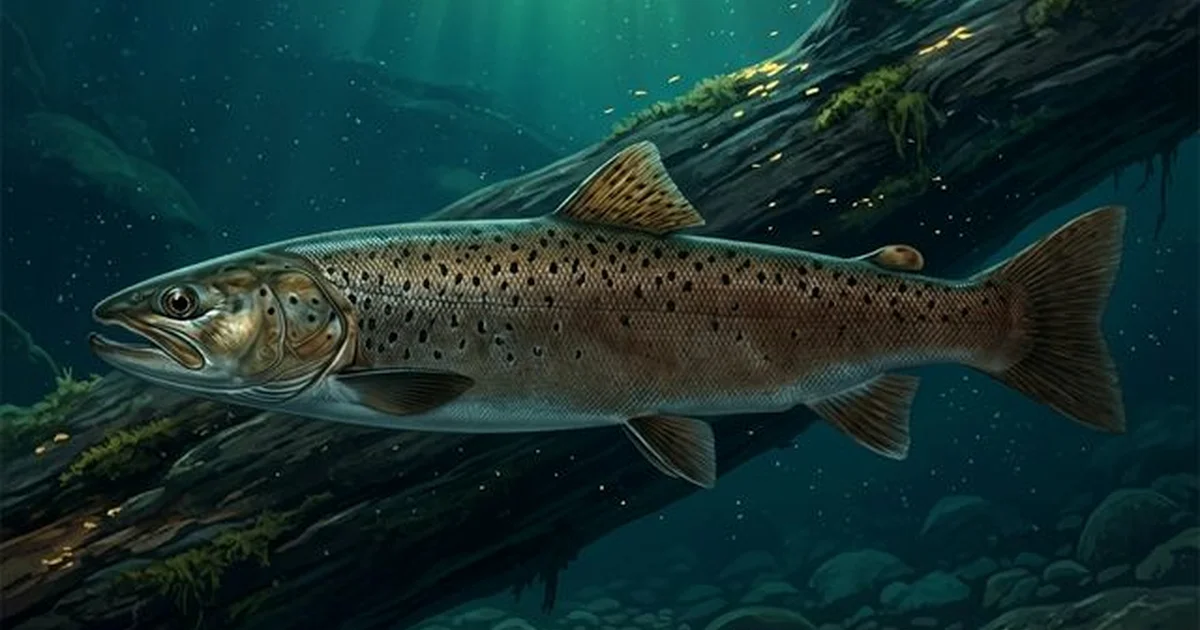
If we call the great white shark a symbol of healthy oceans, then the huchen (Hucho hucho) is the symbol of healthy European rivers. This fish, the largest native salmonid on the continent, exists only in the Danube drainage. Nowhere else in the world. Historically it reached more than 150 centimeters and up to 50 kilograms, sizes that left nineteenth-century anglers speechless. Today such specimens are virtually gone and the species is on the IUCN Red List.
An endemic found only in the Danube
The huchen is unique. Unlike Atlantic salmon or brown trout, which range across multiple continents, Hucho hucho naturally occurs only in the Danube drainage. Its range covers tributaries from the upper Danube in Germany and Austria through Slovakia, Czechia, Hungary, the former Yugoslav countries, all the way to parts of Ukraine.
Pinter et al. (2024, Fisheries), in a historical review of the huchen as a "salmonid flagship," documented that today's subpopulations are confined to discontinuous river reaches making up only about 30 percent of the original range. Most of the loss occurred before 2000 due to river regulation, hydropower and pollution, and the trend has not stopped.
An apex predator that holds the river together
Huchen sits at the top of the food chain of fast, cold sub-alpine rivers. Witkowski et al. (2013, Archives of Polish Fisheries), in a stomach content analysis from Polish rivers, confirmed that large huchen feed almost exclusively on fish, with Alburnoides bipunctatus (spirlin) and chub (Squalius cephalus) as dominant prey. In winter, when other fish are less active, the huchen switches to cyprinids and other salmonids.
As an apex predator, huchen has direct top-down effects on fish community structure. Schmutz et al. (Springer, 2015) stressed that it is an indicator species. Its presence signals not just a large predator but a healthy, continuous river system with a full range of habitats, migration corridors and a diverse prey base. Where the huchen is gone, the river lost the battle long ago.
Spawning that demands perfection
Huchen spawns in early spring, from March to May, when water warms to 6 to 10 degrees Celsius. The female digs a redd in clean, coarse gravel in riffles with strong flow and lays 10,000 to 12,000 eggs per kilogram of body mass. Development is slow, and the fry depend on intact river beds free of fine sediment that would suffocate them.
That is why river fragmentation by dams and hydropower plants is lethal for huchen. A single dam can sever the link between spawning grounds and wintering areas and doom an entire downstream population to gradual extinction. Freyhof and Kottelat (IUCN, 2022) cite hydropower and river regulation as the main driver of the species' global decline.
When there is too much predator
Interestingly, huchen introduced outside its native range can cause the opposite problem. Holčík (1990, FAO) reported that in one stretch of the Hornád River in Czechoslovakia an introduced huchen population reduced native brown trout and grayling so much that it had to be removed. An apex predator in the wrong ecosystem quickly becomes a predator beyond carrying capacity.
This is a reminder that the huchen is not a magic solution for river recovery. It works only within the mosaic of habitats and species with which it co-evolved over millions of years.
In Croatian waters
In Croatia, huchen lives in the Drava, Sava, Kupa, Dobra, Korana, Mrežnica and their tributaries. The upper Drava is one of Europe's most famous huchen rivers, yet even there the species is under constant pressure from flow regulation and hydropower. Protection in Croatia is among the strictest: the closed season runs from February 15 to September 30, and the minimum size is 80 cm. Only one huchen may be kept per season.
Barać et al. (2023), in a monograph on Croatian fauna of the Danube drainage, confirmed that both the genetic diversity and numbers of huchen in Croatia are declining, with isolated populations lacking the gene flow needed for long-term stability. Every fish caught and released is a literal contribution to the genetic future of the species.
A diagnosis, not a trophy
The huchen is not a fish for statistics. It is a diagnosis. As long as huchen is in the river, so are its hundreds of companion species, migration corridors, quality spawning grounds and cold water through the summer months. When the huchen is gone, the river is no longer a real river but a technological channel. Every time you return one to the water, you buy time for it and for everything that keeps it alive.