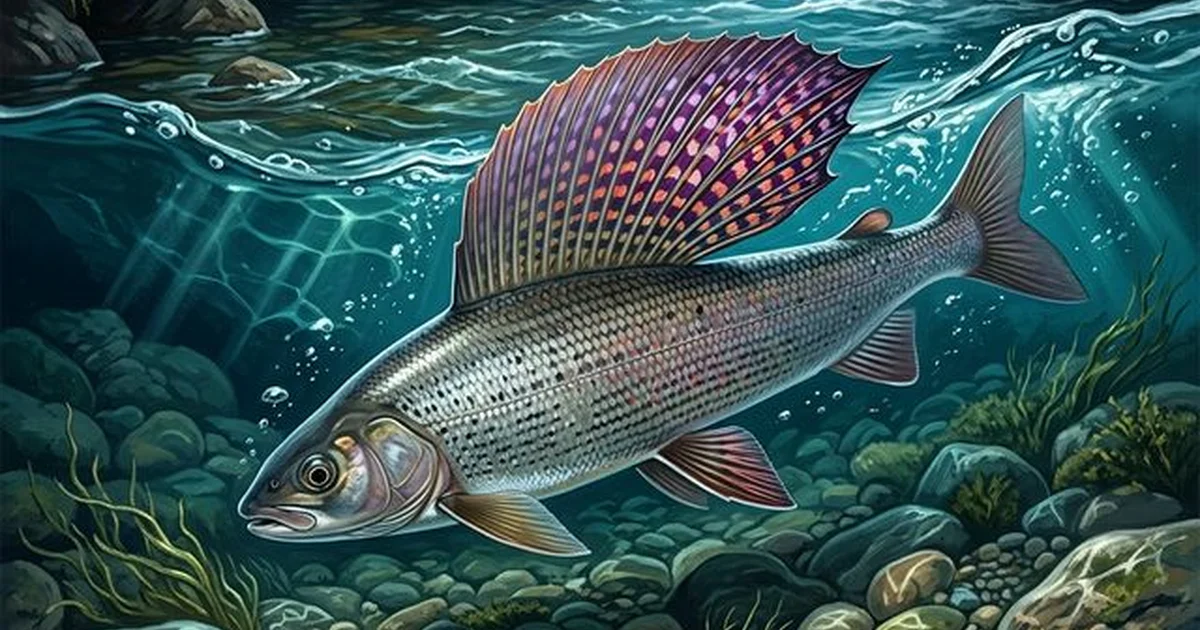
When the European grayling disappears from a river, it is not merely the loss of one species. It is a diagnosis. The grayling is a fish that tolerates no compromises: the temperature must be low, oxygen high, the bottom clean, the current constant. If any of these parameters drops below the threshold, the grayling leaves. Or, more often, simply vanishes. In Germany, populations have fallen by over 90% since the mid-1980s. In Belgium, by 42.8% in just the first two decades of this century. This fish with its stunning dorsal fin is not just telling us about itself. It is telling us about the health of the entire river.
Why grayling cannot live in "good enough" water
The grayling (Thymallus thymallus) belongs to the family Salmonidae and shares many requirements with brown trout. But in some areas, it is even more demanding. It requires dissolved oxygen concentrations of 7 to 10 mg/L, which is at the upper limit of what most European rivers can offer today.
Rosenau et al. (2025, Journal of Fish Biology) investigated the impact of temperature on grayling reproductive success and obtained alarming results: at a water temperature of 10 degrees Celsius, hatching rates decline significantly, and at 12 degrees Celsius, they practically collapse. For a fish that spawns in spring when waters are warming, this means that even moderate warming can destroy an entire generation. Projections for European rivers forecast water temperature increases of up to 3.5 degrees Celsius by the end of the century, which could reduce potential grayling habitat by up to 75%.
The sail-fin that wins mates
The grayling's dorsal fin is one of the most spectacular structures among European freshwater fish. Large, sail-like, scattered with red, purple, and green spots, it rises like a flag above the body. But it is not there just for beauty.
Research on sexual dimorphism in grayling has shown that the dorsal fin is markedly larger in males than in females. Sušnik Bajec et al. (2021, Reviews in Fish Biology and Fisheries) conducted a comparative analysis of sexual dimorphism across all species of the genus Thymallus and confirmed that differences in fin size, especially the dorsal, are the most pronounced among all salmonids. Males with larger fins have an advantage in competing with other males and in attracting females.
During spawning, the male raises his dorsal fin in full splendor and performs slow circular movements around the female. The fin color becomes more intense, the spots brighter, and the entire display serves as a quality signal. A male that feeds better, that lives in better conditions, has a larger and more colorful fin. The female thereby gains reliable information about the quality of a potential mate.
The bottom must be perfect
Grayling spawn on gravel beds in shallow, fast-flowing sections of the river. The female digs a shallow pit in the gravel with her tail fin, deposits eggs, and the male fertilizes them. But for this process to succeed, the gravel must be clean. Fine sediment, silt, and sand that accumulate due to soil erosion, agriculture, or construction work clog the spaces between pebbles and suffocate the eggs.
Declercq et al. (2025, Limnologica) analyzed the causes of grayling population decline in Belgian rivers and identified fine sediments as one of the key factors. Intensive tillage, surface runoff, and rain carry particles that settle on spawning grounds and reduce egg survival. This is a problem the grayling cannot solve through behavioral change, because it is bound to a specific substrate type that cannot be substituted.
Dams that cut rivers in half
The grayling is a potamodromous fish, meaning it migrates within the river system but does not enter the sea. Seasonal migrations are part of its life cycle: it moves upstream toward spawning grounds in spring and downstream toward wintering areas in autumn. Dams and weirs interrupt these migrations and fragment populations.
Weiss et al. (2008, Fisheries Management and Ecology) synthesized the phylogeography and population genetics of the European grayling and warned that habitat fragmentation reduces genetic flow between populations, leading to inbreeding and loss of genetic diversity. In small, isolated populations, this can be as dangerous as direct habitat loss.
Eyes sharper than your finest tippet
Fly anglers who pursue grayling know that this fish has exceptional eyesight. Tippets of 0.10 to 0.12 mm are necessary because grayling can spot thicker nylon in the water. This is not an exaggeration. The grayling feeds through visual selection, watching insects that float on the surface or drift through the water column, and selectively picking individual pieces.
This dependence on vision explains why grayling prefer clear water. In turbid water, its primary hunting strategy becomes ineffective. Pikeperch in murky water hunts better because it relies on its tapetum lucidum. Grayling in murky water cannot hunt at all because it has no alternative sensory system to compensate for lost visibility.
In Croatian waters
In Croatia, the grayling is present in the Adriatic drainage basin, in rivers with cold, clean water. The closed season runs from January 1 to May 15, and the minimum size is 30 cm. In the Kupa and Kupica rivers, the rules are stricter: the closed season runs from October 16 to May 15, and the minimum size is 32 cm.
This difference in regulations between water bodies reflects local assessment of population status. The longer closed season on the Kupa and Kupica suggests that local populations face greater pressure and require additional protection. Respect these rules, because every grayling returned to the river helps sustain a species that is in serious decline across all of Europe.
A thermometer with fins
The grayling is not just a beautiful fish to catch. It is a living measuring instrument. Its presence in a river tells you the water is clean, cold, oxygen-rich, and that the gravel bed is healthy. Its disappearance tells you the opposite, often before any electronic sensor registers the change.
In a world where rivers are warming, silting up, and being fragmented by dams, the grayling is a species that warns us. We can choose whether to listen.