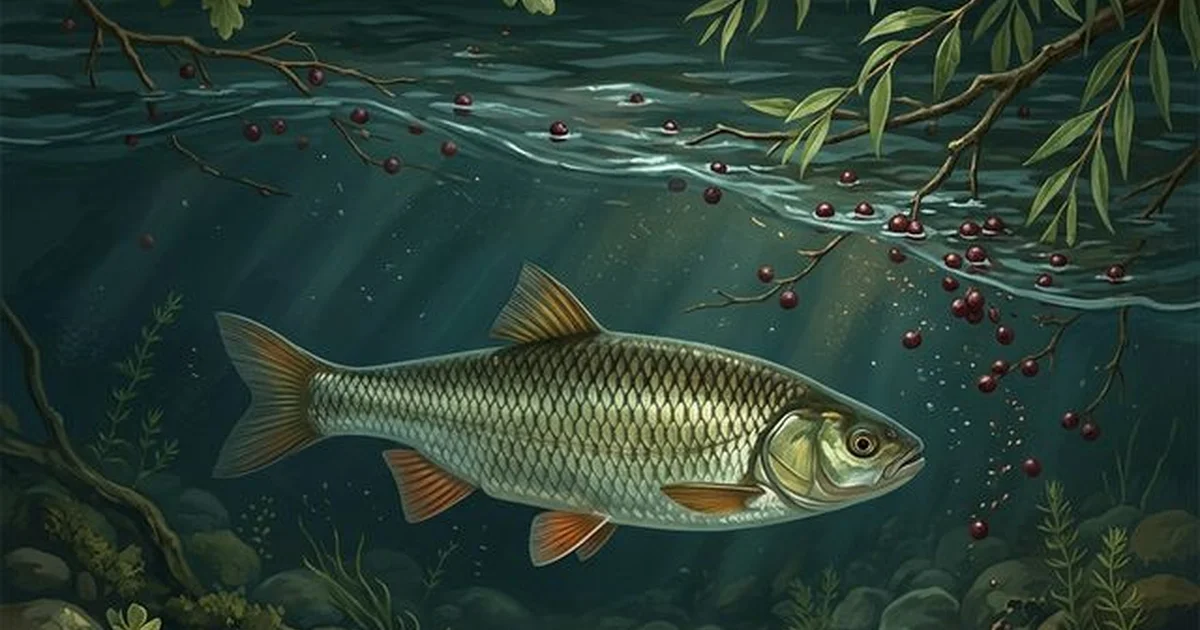
Imagine a fish that eats blackberries. Or cherries. Or a frog that jumped too close to the water. Or moss from a rock. Or insect larvae from the surface. Or a smaller fish that had the misfortune of swimming too close. This is not a made-up species. This is the European chub, our most versatile freshwater fish and perhaps the most intelligent fish in the entire cyprinid family.
A menu with no limits
The chub (Squalius cephalus) is perhaps the only local fish that can be said to eat literally everything. Mann (1976, Journal of Fish Biology) conducted an extensive analysis of chub digestive tract contents from the River Stour in England and documented an incredible breadth of diet: aquatic invertebrates, terrestrial insects that fall on the surface, mollusks, crustaceans, smaller fish, frogs, and even small rodents like water voles.
But what makes the chub truly unique is the plant component of its diet. Unlike most cyprinids that occasionally swallow plant material, the chub actively seeks out fruit. Blackberries, elderberries, and cherries that fall from overhanging branches are regularly found in chub stomachs. This is not accidental ingestion. Chub position themselves beneath overhanging trees and wait for fruit to fall, behaving like aquatic fruit pickers.
Ünver and Erk'akan (2011, Journal of Applied Ichthyology) analyzed 241 specimens of chub and confirmed that the species consumes everything from phytoplankton and zooplankton to fish, macrophytes, and detritus. The proportion of individual food categories changed with season and age, but the breadth of the menu remains consistently impressive.
Why does the chub eat everything? The answer is in its body
The chub has wide, thick lips that allow it to manipulate diverse food items. Its pharyngeal bone carries strong pharyngeal teeth that can crush mollusk shells and crustacean armor, but also handle softer items like fruit and larvae. The combination of wide lips for catching and strong pharyngeal teeth for processing makes the chub one of the most flexible feeders in European waters.
The chub's body is massive and rounded, with a large head that makes up a significant portion of total length. This is not coincidental. A large head means more space for jaw muscles and a larger oral cavity, which facilitates catching diverse prey. The scales are large, shiny, and have a characteristic dark edge that gives the chub a netted pattern.
A fish that learns to avoid hooks
Anglers know this from experience: small chub bite at everything. Large chub are nearly impossible to fool. This is not anecdote. Research on learning in fish shows that cyprinids have a pronounced ability to learn to avoid negative stimuli.
Lovén Wallerius et al. (2020, Transactions of the American Fisheries Society) demonstrated that cyprinids can learn to avoid hooks after a single negative experience, and that this avoidance can last for months. Moreover, fish can learn to avoid hooks by observing other fish that have been caught, through a process of social learning. Brown and Laland (2003, Fish and Fisheries) documented that social learning in fish is widespread and includes the transfer of information about food, predators, and habitat.
In the chub, this learning ability results in an extreme behavioral change with size. Young chub of 15 to 20 cm are bold, curious, and attack almost any bait. Old chub of 50 cm and above become extremely cautious, choosing positions with good visibility, avoiding unfamiliar objects, and reacting to the slightest disturbance. For the angler, this means catching a large chub requires a completely different approach than catching a small one.
Adaptability that outperforms specialists
While the grayling cannot separate from cold, fast currents and pikeperch requires murky water, the chub lives everywhere. Rivers, lakes, canals, fish ponds, brackish waters near estuaries. From Scandinavian rivers to Mediterranean streams. From fast mountain currents to the slow lower reaches of lowland rivers.
This adaptability has a physiological basis. Research on the thermal preferences of chub showed that the species prefers temperatures around 25.5 to 25.7 degrees Celsius but tolerates a range from 4 to 30 degrees Celsius (HAL Archives, 2024). This is an exceptionally wide range for a freshwater fish and explains why the chub succeeds in waters where specialists cannot.
Britton et al. (2023, Hydrobiologia) studied the trophic relationships of translocated chub populations and showed that the chub quickly adapts to new habitats, occupying a similar trophic position as invasive crayfish. The chub is not merely a generalist. It is a professional generalist that actively finds and exploits every available niche.
Chub or dace? An important distinction
In Croatia, two similar species coexist: the chub (Squalius cephalus) and the dace (Leuciscus leuciscus). Confusion is common, but the differences are clear when you know what to look for. The chub has a larger head, wider mouth, and more rounded body. The dace is slimmer, with a smaller head and narrower mouth. The chub grows up to 80 cm, while the dace rarely exceeds 30 cm.
The easiest distinction is the shape of the anal fin. In the chub, the anal fin is convex (curved outward), while in the dace, it is concave (curved inward). This difference is reliable across all age groups and populations.
In Croatian waters
The chub is present in nearly all freshwater bodies in Croatia. There is no closed season and no minimum size limit for this species, meaning it can be caught year-round. This makes it one of the most accessible fish for anglers of all experience levels.
But do not underestimate it. Chub over 3 kg exist in Croatian waters and present a challenge that will test every skill you have. These are fish that have survived decades avoiding hooks, predators, and every other danger. They deserve respect.
An omnivore with a degree
The chub is a fish that breaks stereotypes. It is not a predator, but it eats fish. It is not a herbivore, but it eats fruit. It is not a specialist, but it outperforms specialists in adaptability. And what makes it particularly interesting: it learns from experience faster than most anglers expect. Next time you cast your bait beneath a willow canopy along the bank, know that on the other side you may be watched by a fish that has already seen every trick in your arsenal.