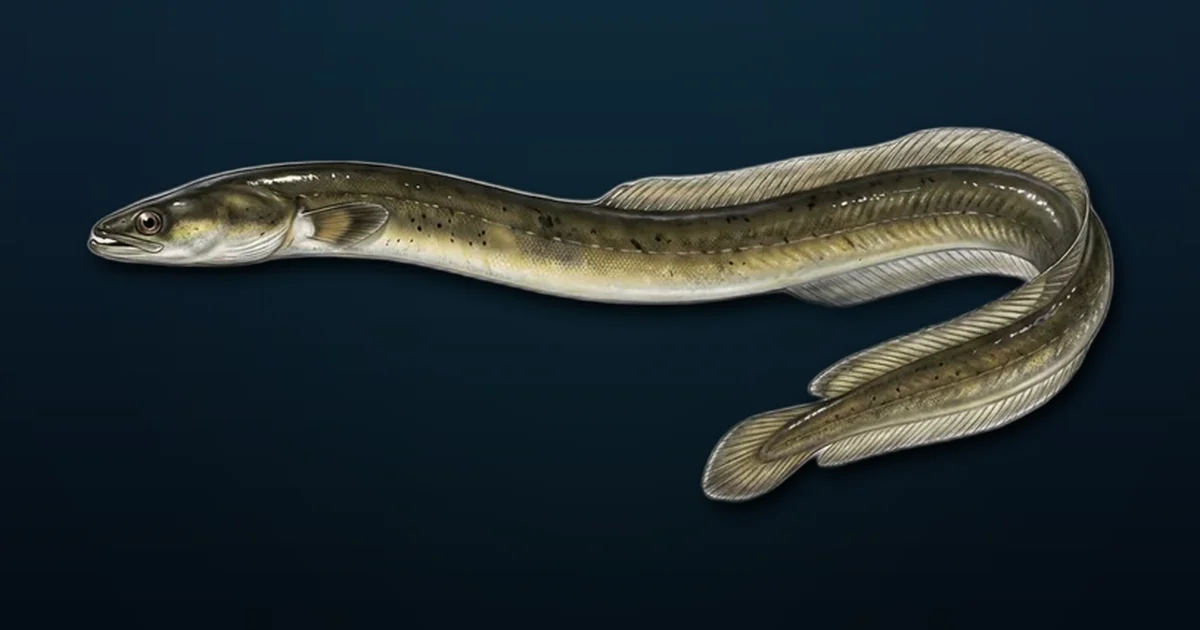
In 1876, a young medical student named Sigmund Freud spent weeks in Trieste dissecting hundreds of eels. He was looking for one thing: a male. He never found one, and neither had anyone in nearly two thousand years of naturalists before him. Aristotle concluded that eels simply arose from mud, because he never saw their eggs or milt. The eel is still the fish around which science keeps assembling the strangest reproductive story in our waters.
A fish that lives in the river and spawns in the ocean
A salmon does one thing: it grows up at sea and spawns in the river. The eel does the exact opposite. It is called catadromy, and it means the eel spends most of its life in fresh water, then sets out on a journey of more than 6,000 kilometres to spawn in the sea. And not just any sea, but a single place on the planet: the Sargasso Sea in the western Atlantic.
How we know about the Sargasso if no one has seen the spawning
The Danish oceanographer Johannes Schmidt spent almost two decades dragging nets across the Atlantic and measuring eel larvae. The logic was simple: the smaller the larva, the closer to where it hatched. The map led him straight to the Sargasso Sea (Schmidt, 1923, Philosophical Transactions of the Royal Society B). There the larvae are smallest, only a few millimetres. Larval surveys identified the presumed spawning area. A 2022 satellite-tracking study also followed adult European eels into that area in the Sargasso Sea (Wright et al., 2022, Scientific Reports); reaching the area is not the same as observing spawning itself.
A transparent leaf that drifts home
An eel larva does not look like a fish. It is called a leptocephalus and is shaped like a transparent willow leaf. The Gulf Stream carries it toward Europe for one to three years. When it reaches the coast it transforms into a glass eel, a see-through rod that enters the rivers. Only in fresh water does it gain colour and become a yellow eel, a stage it can hold for as long as twenty years.
One family for all of Europe
Every European eel belongs to a single population that mixes in the Sargasso Sea. Genetic analysis of thousands of individuals showed there are no separate river strains: an eel from the Neretva and an eel from Ireland are the same genetic stock (Als et al., 2011, Molecular Ecology). This is called panmixia, and it explains why the collapse of one river hurts the entire species.
The first time anyone tracked them
Only in 2016 did scientists fit adult eels with satellite tags and, for the first time, empirically follow their migration toward the Azores and the Sargasso Sea (Righton et al., 2016, Science Advances). They found the eels travel slower than expected, in deep daily dives, and that many probably need more than a year to arrive. They travel hungry, because before the journey the silver eel stops feeding and its gut degenerates.
A sex that depends on the crowd
An eel has no fixed sex at birth. The environment decides: in dense, crowded habitats more males develop, while where there is space and food more females appear, and they grow larger. So river regulation and barriers change not only how many eels survive, but what kind.
Critically endangered, and most people do not know it
The arrival of glass eels into European rivers has fallen by more than 90% since the 1980s. The International Union for Conservation of Nature lists the European eel as critically endangered (Jacoby and Gollock, IUCN Red List). The causes are barriers and hydropower that cut the migration route, habitat loss, pollution, parasites and trafficking: glass eels are among the most trafficked animals in the world by value.
The eel in Croatian waters
Here the eel was historically known in the Neretva and coastal waters, and once reached the lower Danube and Sava before the large barriers. Today it is increasingly rare. If you catch one, check the current rules and closed season in your water district before deciding what to do next: this is a species that counts every spared individual, because every female that makes it back to the Sargasso carries up to several million eggs.
Why this fish deserves respect
The eel outlived the dinosaurs, the ice ages and two thousand years of humans who thought it grew from mud. What nearly broke it were concrete barriers and nets set at the mouths of rivers. Next time you see that dark, snake-like shadow in the shallows, remember it is looking at a home 6,000 kilometres away, and that if you let it go, it will try to get there.