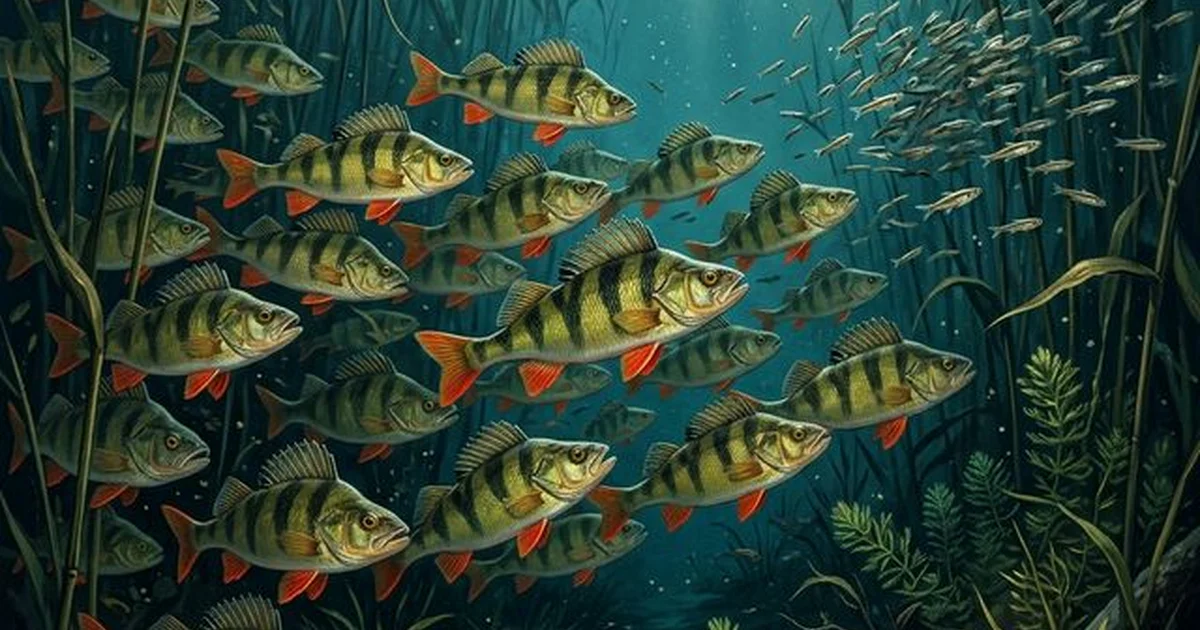
Most anglers view the European perch as a "starter fish," something kids catch while waiting to grow into pike. But this fish, locally known in Croatia as bandar, hides hunting strategies that neither pikeperch nor pike employ. The European perch is the only local predator that hunts in coordinated groups, and its five to eight dark vertical bars serve a function that biologists have studied for over half a century.
Why perch hunt in packs while pike hunt alone
Peter Eklöv at Uppsala University published a study in 1992 that directly compared the efficiency of group-hunting perch with solitary-hunting pike. The results were unambiguous: perch that hunted in groups grew faster than those hunting alone, even at equal prey density (Eklöv 1992, Animal Behaviour). Pike, on the other hand, gained no benefit from group hunting. Its ambush strategy demands solitude and patience. Perch do the opposite.
When a school of perch encounters a group of roach or bleak, they do not rush in all at once. Instead, the school surrounds the prey and gradually compresses it into an increasingly tight cluster. Individual perch then make short, rapid strikes into the center of the prey school while the rest of the group maintains pressure from the flanks. Turesson and Brönmark (2004, Journal of Fish Biology) documented that perch deliberately single out individual prey from the school, repeatedly attacking the same target until they catch it.
Stripes that break the body outline
European perch have five to eight dark, vertical stripes on a yellow-green body. At first glance, they look decorative. But in biology, vertical stripes on a fish body serve a precise function: this is a form of disruptive camouflage that breaks up the body outline and makes it harder for predators to recognize the shape of the fish.
Among reeds and aquatic vegetation, where perch spend much of their lives, vertical stripes blend with the vertical stems of plants. A predator looking into a reedbed does not see a fish shape but rather a series of fragments that merge with the surroundings. Saulamo and Brönmark described how perch coloration changes depending on habitat. In clear, open water, stripes are less pronounced, while in vegetation-rich areas they become more contrasted (Saulamo and Brönmark 2011, Biological Journal of the Linnean Society).
Interestingly, each perch has a unique stripe pattern, like a fingerprint. The number, width, and shape of stripes differ enough that researchers use them for individual identification in field studies (Oksanen et al. 2015, Journal of Fish Biology).
Three lives in one: how diet changes with size
Most freshwater fish eat roughly the same food throughout their lives. Perch do not. They go through three distinct dietary phases, each requiring a completely different hunting strategy and habitat.
The first phase begins immediately after hatching. Larvae and young perch up to about 50 mm live in the pelagic zone and feed on zooplankton, primarily daphnia and copepods. At this stage, the perch is a filter feeder, not a hunter.
When it reaches 80 to 120 mm, the perch moves to the bottom and starts eating benthic invertebrates: caddisfly larvae, mayfly nymphs, and amphipods. This transition requires a complete behavioral change. Instead of swimming in the open water column, the perch now searches through gravel, rocks, and submerged structures. Persson and Greenberg (1990, Oikos) showed that this shift is constrained by gape size: only perch that grew fast enough to reach a critical mouth size could switch to larger invertebrates.
The third phase arrives at a length of roughly 150 to 240 mm. The perch then becomes a piscivore. Adult perch hunt roach, young bleak, and even smaller perch. Cannibalism is not the exception but a regular occurrence in dense populations. Persson et al. (2000, Ecology) documented that cannibalism in perch populations can regulate entire population dynamics, keeping juvenile numbers in check.
The spiny armor fin
Perch have two dorsal fins, a hallmark of the Percidae family and an unusual feature among freshwater fish in the region. The first dorsal fin contains 13 to 17 hard, spiny rays that serve exclusively for defense. When the perch feels threatened, it raises the first fin like a shield, making itself appear larger and less appealing to swallow.
This defense is so effective that even pike avoid larger perch specifically because of these spines. Many anglers know that pike swallow perch head-first, but fewer realize that pike often reject perch they attempt to swallow because the spines of the first dorsal fin lodge in the throat. This is one reason perch can coexist with pike in the same lake: they have a built-in defense mechanism that makes them costly prey.
Red fins are not just for show
The pelvic, anal, and pectoral fins of the perch are intensely red to orange. This color comes from carotenoids, pigments that perch cannot synthesize on their own but obtain from their food. The better a perch feeds, the redder its fins become.
In biology, carotenoid coloration is a common signal of individual quality. Red fins may signal to other perch in the school that this individual is in good condition, facilitating the formation of efficient hunting groups. Research by Saulamo and Brönmark (2011, Biological Journal of the Linnean Society) showed that perch coloration is a trade-off between camouflage and communication, with red fins serving as signals while stripes serve for concealment.
In Croatian waters
The European perch is one of the most widespread fish in Croatia. It is present in nearly all lowland rivers, lakes, oxbow lakes, and fish ponds. There is no closed season and no minimum size limit for perch, meaning it can be caught year-round without size restrictions.
That does not mean it should be underestimated. Perch over 2 kg are uncommon, and specimens above 3 kg are genuine trophies. A perch that large requires 15 to 20 years of growth under favorable conditions. Keep that in mind the next time you land a big bandar.
What this means for your next trip
The European perch is not an "easy fish." It is a species with complex social structure, coordinated hunting, and a triple dietary shift over its lifetime. Next time you feel that tug on a small spinner along the edge of a reedbed, you know what is on the other end: a hunter that has been honing its craft in a pack for years, hidden behind stripes that make it invisible.