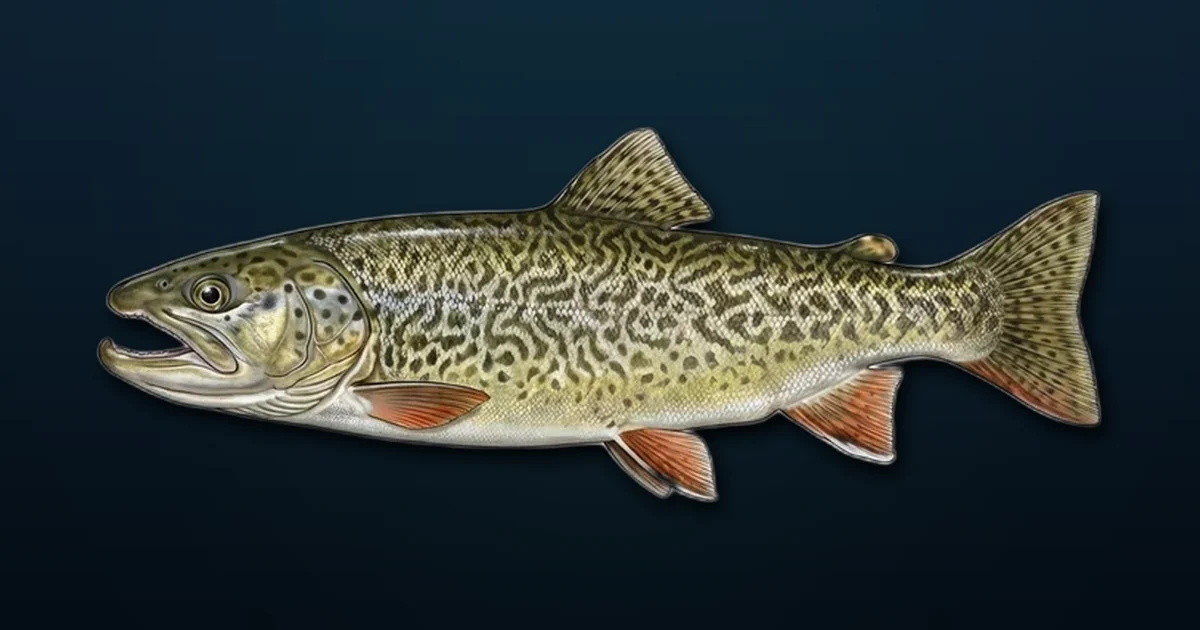
In the clear karst rivers of the south lives a fish most anglers will never catch. The marble trout is the largest trout of the Adriatic basin, a marbled predator that hangs motionless near the bottom and waits. And the greatest threat to its survival is not a net or a hook, but a fish that looks almost identical to it.
Marble that vanishes into stone
It is named for its head, but you recognise it by its skin. Instead of round spots the marble trout wears a marbled, winding pattern that makes it nearly invisible over the gravel and stone beds of karst rivers. This is not decoration but ambush: the marble trout is an ambush predator, and the pattern breaks up its outline in the shifting water.
An endemic that lives only here
The marble trout (Salmo marmoratus) naturally occurs only in the rivers of the Adriatic basin, from the Soca in the north to the Dalmatian rivers. That makes it an endemic: it exists nowhere else on Earth. Rivers such as the Neretva and its tributaries are part of that narrow, vulnerable range. A restricted range means the whole species leans on just a handful of river systems.
The apex predator of the karst river
Unlike the brown trout, which often feeds on insects, the adult marble trout is a committed fish-eater. It takes the best lies in the river and rules from them. That is why it grows large: individuals heavier than 20 kilograms have historically been recorded, placing it among the largest trout on the planet. The big fish are old, slow-growing and rare, and it is precisely they that matter for rebuilding the population.
The real threat looks just like it
The most dangerous enemy of the marble trout is the brown trout introduced through stocking. The two species interbreed and produce fertile hybrids, so the pure marble-trout genes gradually dissolve into the mix. A genetic study of the remnant populations in Slovenia showed how isolated and impoverished they are, and how real the introgression of foreign genes is (Fumagalli et al., 2002, Molecular Ecology). In other words, you can have a river full of trout while the true marble trout goes genetically extinct.
Rescued in the headwaters
Conserving the marble trout has come down to finding and protecting the few genetically pure populations, often in isolated upper reaches that introduced brown trout never reached. Slovenia launched a long-term recovery programme built on exactly that principle: find the pure fish and build from them (Crivelli et al., 2000, Cybium). Without it, the marble pattern would slowly fade into ordinary spots.
The marble trout in Croatian waters
Here the marble trout lives in the Neretva basin and related Dalmatian rivers, in cold, clear, fast reaches. It grows slowly and matures late, which makes it extremely sensitive to overfishing. Before you go, check the closed season, the minimum size and the protection status in your area, because for a fish this rare and slow, every big individual spared is worth an entire small spawning run.
Why a big marble trout should go back
A big marble trout is not a trophy you can easily replace. It is a decades-old female carrying genes tuned to that exact river. If you keep it, you have taken more than one fish: you have taken a piece of the future of a population that exists only here. Stocking brown trout on top of marble trout is not help for the river, but its quiet erasure. The best thing you can do for the marbled giant is photograph it and return it to the lie it rose from.