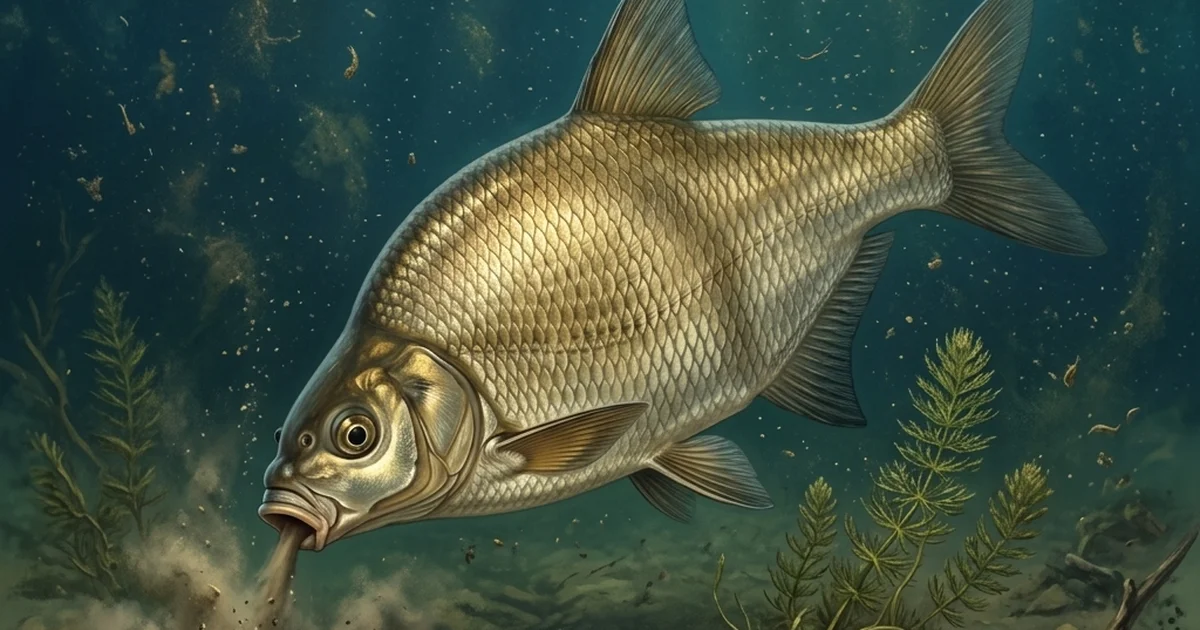
Over half a meter long, flat as a plate, with a mouth that extends into a small telescope, common bream (Abramis brama) has a reputation in Croatian rivers and lakes as a boring fish. Something you catch when the zander is not biting. That reputation hides one of the most sophisticated feeding strategies in the freshwater world. Bream does not just filter plankton. It does it selectively, picking particle size and prey type by tuning its gill sieve in real time.
Two professions in one fish
Most of the time bream is a benthivore, feeding from the bottom of a river or lake. It extends its telescopic mouth into the mud, sucks up sediment, spits out the unproductive part and keeps bloodworms, chironomid larvae, small crustaceans and snails. When large invertebrates are abundant, that is enough.
However, when bream finds itself in turbid, eutrophic water where the benthos is depleted or hard to reach, it switches to a second mode: filter feeding on plankton. Van den Berg et al. (1994, Environmental Biology of Fishes) developed a "switching" model that describes how bream chooses between the two modes depending on the density of each type of prey.
How the slimy filter works
The classic picture of a filter feeder is a fish that holds its mouth wide open and passes water across its gills. Hoogenboezem et al. (1997, Journal of Experimental Biology) used X-ray cinematography to see, for the first time, what actually happens inside a bream's mouth in real time. They uncovered a mechanism far more complex than passive filtering.
Bream sucks in a gulp of water, closes its mouth and performs movements of the palatal organ, a structure on the roof of the mouth, and the gill rakers. Lateral rakers rotate and change the effective pore size of the gill sieve. When particles are the "right" size for the current food type, bream traps them. When they are smaller, it lets them pass back into the water.
The key moment is capture. Van den Berg et al. (1994) showed that the channel walls between rakers are coated with mucus, and a particle that touches that mucus becomes sticky. The fish does not need to hold the particle mechanically through the whole cycle, only for part of it, because mucus does the rest. This is why bream can retain up to 900 individual plankton organisms in one gulp, of specific sizes, while rejecting everything else.
Why a big bream cannot catch Daphnia
This ability has a limit set by the fish's own body. As bream grows, its gill rakers spread apart and the gaps between them widen. Uvan and Lammens (1989, Environmental Biology of Fishes) tested a filter-feeding model for bream and found that above about 40 centimeters length the rakers become too wide to retain small Daphnia and copepods. A large bream can still take large plankton and benthos but loses access to the most abundant planktonic resource.
That is why bream populations in many European lakes stall around 40-45 cm. Above that length the energy balance no longer supports further growth.
Ecology: a fish that changes the color of a lake
Bream does not just change its own diet. It changes the entire lake. Breukelaar et al. (1994, Freshwater Biology) measured the effect of benthivorous bream on sediment in Dutch lakes. The result: each 100 kilograms of bream per hectare increased sediment resuspension by 46 grams per square meter per day, and the light extinction coefficient rose by 0.34 m⁻¹. In plain terms, where there is more bream, the lake turns murkier, sunlight no longer penetrates to the bottom, and macrophytes suffer.
This is exactly why bream removal is one of the main methods of biomanipulation. Jeppesen et al. (2007, Freshwater Biology) monitored Lake Væng in Denmark, where benthivorous fish were removed twice over 30 years. The lake shifted from a turbid, phytoplankton-dominated state to a clear, macrophyte-dominated one. Chlorophyll a dropped from 60-80 μg/L to 10-30 μg/L. Same lake, same water, just fewer bream.
In Croatian waters
In Croatia, bream is widespread in the lowland parts of the Black Sea drainage: the Danube, Sava, Drava and their side arms, oxbow lakes and reservoirs. It prefers slow, deep stretches with muddy bottoms and abundant plankton or benthos. The closed season runs from April 15 to May 15 in most water bodies, and the minimum size is 25 cm.
Fishing for bream is mostly done on bottom rigs with boilies, corn and worms. But when you pull one from the water, take a moment and look at its mouth. What you are holding is not a boring flat fish but one of the most precise filters in the entire freshwater world.
The engineer of murky waters
In Croatian waters bream is at the same time the creator and the victim of turbid lakes. Its benthic activity lifts sediment, yet in the same murky water that feeding mode becomes a necessity. The murkier the water, the more useful bream's filter feeding becomes, and the more abundant bream is, the murkier the water. A small perfect feedback loop of evolution, documented in every eutrophic lake in Europe.