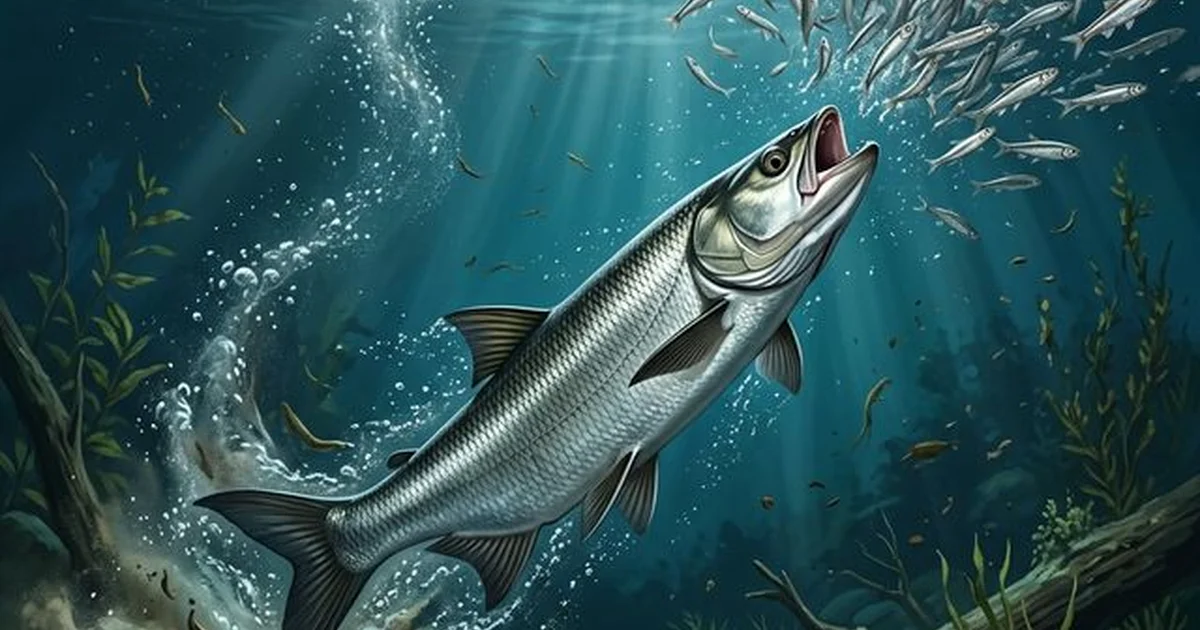
In the family Cyprinidae, which includes more than 3,000 species, nearly all are peaceful fish. They eat algae, insects, mollusks, plants. None of them chase other fish across the water surface. None except the asp. The asp, locally known in Croatia as bucov, is the only true predator among cyprinids, a fish that has developed a completely different set of tools from all of its relatives.
The only predator in a family of 3,000 species
When we say the asp is the only predator in the family Cyprinidae, that is not an exaggeration. While the chub occasionally feeds on smaller fish, it is an opportunist that bases most of its diet on insects and plant material. The asp is an obligate piscivore. From the moment it reaches a length of roughly 10 cm, its diet consists almost exclusively of fish. Krpo-Ćetković et al. (2010, Journal of Applied Ichthyology) analyzed stomach contents of 198 asp from the Danube near the Sava confluence and found exclusively fish: predominantly bleak, followed by roach and Prussian carp.
This is an evolutionary exception. The family Cyprinidae has no jaw teeth. Instead, cyprinids have pharyngeal teeth, located deep in the throat. The asp has found a way to hunt fish without true jaw teeth, using speed, suction power, and a bony protrusion on the lower jaw that helps grip slippery prey.
A mouth that adapts to prey in real time
Van Wassenbergh et al. (2011, Zoology) conducted a laboratory study in which they recorded high-speed cameras while asp attacked live fish. They discovered something unexpected: the asp actively modulates its suction feeding kinematics depending on prey behavior. When the prey attempted to escape, the asp prolonged mouth opening and increased hyoid depression, boosting suction power.
In other words, the asp does not attack with the same mechanical motion every time. It reads the prey's reaction and adjusts the attack in real time. This is a level of sophistication rarely seen in fish, and even more rarely in cyprinids. The researchers concluded that the asp uses a combination of a ram strike and adaptable suction, making it an exceptionally effective hunter despite lacking true predatory teeth.
Surface attacks you can hear from the bank
Anglers on the Danube, Drava, and Sava know how to recognize an asp by sound. When a school of bleak swims near the surface, the asp attacks from below, breaking through the surface with an explosive splash audible from 50 meters away. It uses the water surface as a barrier, driving prey upward where there is nowhere to escape.
This tactic is unique among freshwater fish in the region. Pike attacks from ambush, usually horizontally or diagonally. Pikeperch hunts from depth at dusk. The asp is the only one that uses a vertical attack toward the surface, combining speed, surprise, and the physical barrier of the water. Its body is perfectly adapted to this hunting style: elongated, hydrodynamic, with a deeply forked tail that enables explosive sprints.
From schools to solitude: how the bucov matures
Young asp live in schools. This makes sense for a fish that is not yet large enough to hunt alone. Schools of juvenile asp collectively attack schools of small fish, using a surrounding tactic similar to perch. But as the asp grows, its behavior changes radically.
Adult asp are solitary. Large specimens occupy territories at tributary mouths, beneath bridges, or at spots where current breaks against obstacles. Kärgenberg et al. (2020, Journal of Fish Biology) tracked asp migrations using telemetry and discovered that adults show complex migration patterns, moving between lakes, rivers, and tributaries across all seasons, but with a tendency to repeat the same routes from year to year.
Spawning occurs in spring, usually in April and May, in fast, shallow waters with gravel bottoms. The triggering temperature is low, around 6 degrees Celsius, which means the asp spawns among the earliest in the season. Males reach sexual maturity only in their fifth year of life.
How large does it actually get?
The asp can grow up to 120 cm and weigh over 12 kg. This makes it one of the largest cyprinids in Europe and by far the largest predator within the family. Average specimens on the Danube measure between 40 and 70 cm, but fish over a meter are not mythical, particularly in the lower reaches of major rivers.
Krpo-Ćetković et al. (2010) calculated Von Bertalanffy growth parameters for the Danubian population, arriving at a theoretical maximum standard length of 526 mm (corresponding to roughly 620 mm total length for the average population). Fulton's condition factor increases with fish size, from 0.70 in younger specimens to 0.83 in older ones, indicating that larger asp proportionally exploit available resources more efficiently.
A protected species of European significance
The asp is listed in Annex II of the EU Habitats Directive (92/43/EEC), meaning member states must designate special conservation areas for this species. It is also protected under Appendix III of the Bern Convention. On the IUCN Red List, it is classified as Least Concern globally, but local populations, especially in smaller rivers, can be threatened by watercourse regulation and destruction of spawning sites.
In the context of Croatian fishing, the asp is a species that deserves respect. Its role in the ecosystem is regulatory: as a top predator in the cyprinid segment of the fish community, the asp controls populations of small fish such as bleak and roach.
In Croatian waters
In Croatia, the asp inhabits areas around tributary mouths and lakes connected to rivers. The closed season runs from April 1 to May 31, and the minimum size is 40 cm. It is important to note that these restrictions apply specifically to the Danube side arms: Poretak, Ostrovski, Vučedolski, Opatovački, and Renovski. For other waters, check local regulations before heading out.
A torpedo with a toothless jaw
The asp is proof that evolution does not require obvious tools to create a top predator. Without true jaw teeth, without camouflage stripes, without venom, it has developed something perhaps even more impressive: speed that turns a calm river surface into chaos, a mouth that adapts to every prey item, and a body that merges cyprinid elegance with predator power. The bucov is not just a fish. It is an evolutionary experiment that succeeded.