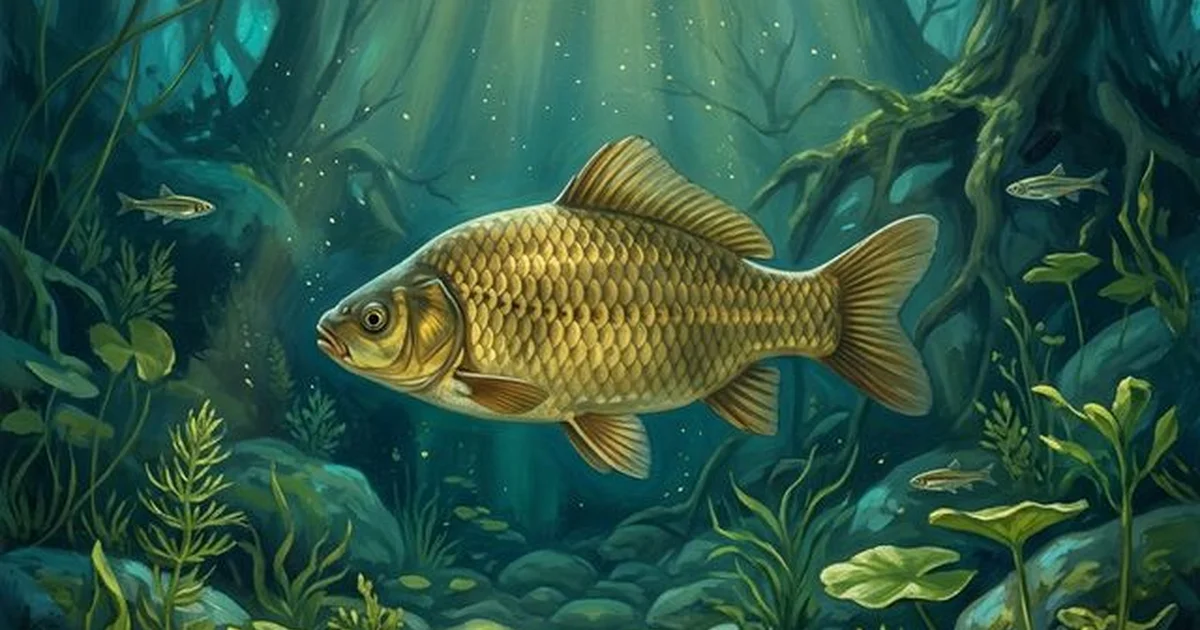
Imagine a fish that doesn't need a male to reproduce. It sounds like science fiction, but that's exactly what the Prussian carp (Carassius gibelio) does, a fish that has conquered virtually every freshwater body in Croatia in just a few decades.
What is gynogenesis?
Gynogenesis is an extremely rare form of reproduction among vertebrates. The female Prussian carp lays eggs that develop without true fertilization. A sperm cell from a male of another species enters the egg and triggers embryo development, but its genetic material never merges with the mother's, it's simply discarded.
The result? Every fish that hatches is a genetic clone of the mother. The entire Prussian carp population in Croatian waters consists almost exclusively of females.
The borrowed sperm trick
To trigger the development of her eggs, the Prussian carp spawns alongside males of related cyprinid species, most commonly common carp, bream, roach, or white bream. These males release milt that contacts the Prussian carp's eggs, but the male's genetic contribution is completely absent.
The sperm serves only as a trigger, like a key that starts an engine but doesn't steer the car. The Prussian carp literally "borrows" milt from other species with zero genetic gratitude.
Staggering numbers
A single sexually mature female can lay up to 400,000 eggs in one season. She reaches sexual maturity at just 3-4 years old, at a length of about 20 centimeters.
Since reproduction doesn't require a male of her own species, every individual in the population is a potential mother. In most other fish, only half the population (females) produces offspring, whereas with the Prussian carp, every single fish does.
The secret weapon: triploidy
The Prussian carp has three sets of chromosomes instead of the usual two (called triploidy). This gives her additional genetic stability for clonal reproduction. Interestingly, research published in Nature Scientific Reports (2015) showed that some Prussian carp clones can simultaneously use both gynogenesis and classical sexual reproduction, a unique case in the animal kingdom.
The conqueror of Croatian waters
The Prussian carp originally comes from Asia, from where it spread across all of Europe. It arrived in Croatia a few decades ago and today there is no freshwater body where it doesn't live. Its ability to reproduce rapidly, resistance to poor conditions, and wide dietary range make it one of the most successful freshwater invaders.
For local fish communities, the Prussian carp represents serious competition because it occupies space and food from native species like the crucian carp (Carassius carassius), with which it can even hybridize.
Fun fact
Gynogenesis is so rare among vertebrates that it's known in only about ten fish species on the entire planet. The Prussian carp is the most famous and widespread example, living proof that evolution sometimes finds solutions that sound completely unbelievable.