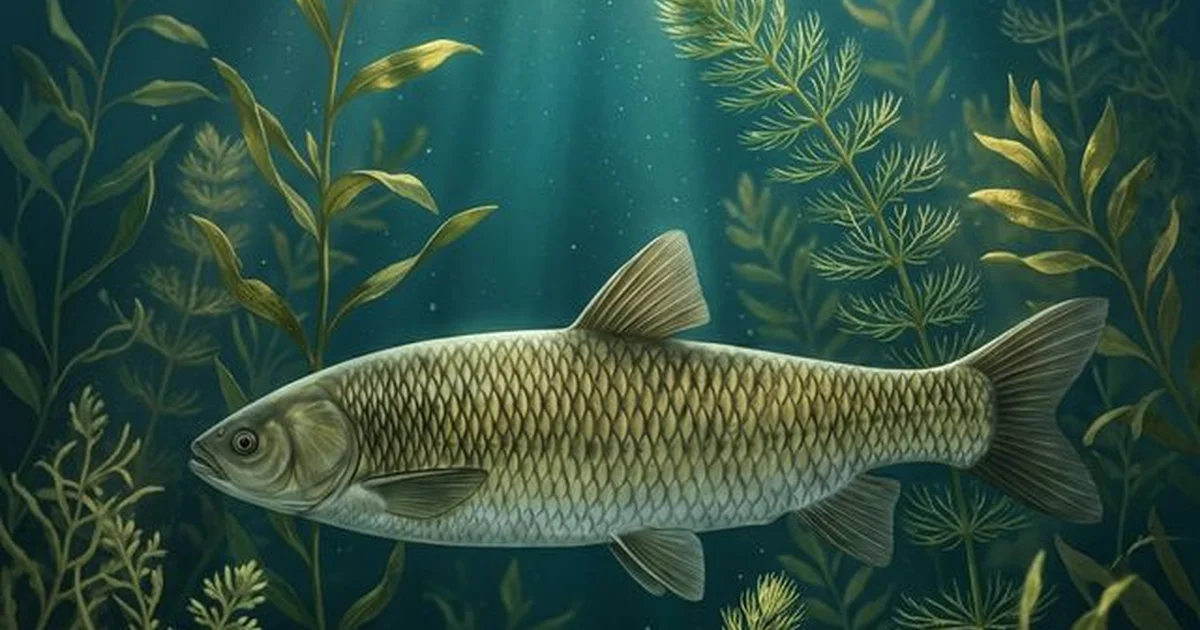
When you spot a quiet, dark dorsal fin cruising through shoreline vegetation in a Croatian reservoir, you are probably looking at a grass carp (Ctenopharyngodon idella). And you are almost certainly looking at a fish that was not born there, whose ancestors never spawned there. Grass carp exists in Croatia solely because people restock it every year. The reason is not the fish's reproductive biology but river physics.
An egg that must float
Grass carp is a rare example of a cyprinid with pelagic, semi-buoyant eggs. When it spawns, the female releases eggs that are only slightly heavier than water. To develop, they must stay in suspension, drifting gently with the current. If they sink to the bottom, they suffocate.
To stay suspended, the eggs need continuous turbulence provided only by fast flow in a sufficiently long river. Stanley et al. (2023, Reviews in Fish Biology and Fisheries), in a review of Asian carp reproductive biology, concluded that grass carp requires an open river stretch of more than about 100 kilometers and flow velocities above a certain threshold for the eggs to develop at all. Below that threshold, the embryo does not survive.
Why Croatia lacks such a river for grass carp
The Croatian Ministry of Environmental Protection (MINGO, 2019), in a monograph on alien freshwater fish in Croatia, states that grass carp does not reproduce naturally in Croatian waters. The reasons are fragmented rivers, regulated flows, reservoirs, and stretches too short to provide the right hydraulic profile. Spawning can happen, but eggs do not survive to hatching.
Chapman et al. (2013, Canadian Journal of Fisheries and Aquatic Sciences), studying the first confirmed self-sustaining grass carp spawning in the Great Lakes, concluded that grass carp reproduces successfully in only six or seven of the largest Northern Hemisphere river systems. The Danube is not among them, despite its length, because its key tributaries are severed by dams that break continuous flow.
A vegetation-eating machine
This is exactly why fish farmers and reservoir managers imported grass carp: to control aquatic vegetation. Grass carp is a strict herbivore and eats up to 40 percent of its body mass per day in plant matter when water is warm. Primorac et al. (2015, Aquaculture International) documented that a single 10 kg adult can remove several hundred kilograms of aquatic vegetation in a single season.
Farmers love it. But ecologists are more cautious, because removing vegetation does not affect plants alone.
Ecology: when the plants go, so does everything else
Richard et al. (1985, Hydrobiologia) ran the most cited experiment on the consequences of grass carp vegetation removal. In four Florida lakes they tracked zooplankton before and after complete macrophyte loss. Results were clear: zooplankton species diversity dropped, and the community shifted from copepods to small rotifers and tiny cladocerans. Total zooplankton density rose, but the large filter feeders that keep phytoplankton in check disappeared.
Gulati and van Donk (2002, Hydrobiologia), reviewing European biomanipulation experience, warned that such macrophyte loss often flips lakes from a clear to a turbid state. Macrophytes are not just "plants." They stabilize sediment, shelter fry, filter nutrients and sustain complex food webs. Grass carp does not distinguish an important plant from an annoying one.
Why this matters for Croatia
Grass carp in Croatian waters exists almost exclusively in closed or semi-closed water bodies: carp ponds, reservoirs and oxbow lakes. Because it cannot sustain a population on its own, every grass carp in the water is there because someone put it there. The closed season runs from April 1 to May 31 and the minimum size is 40 cm.
For anglers this means two things. First, fishing pressure on grass carp does not affect a "local population" in the classical sense because there is no such thing without humans. Second, introducing grass carp into a new water without monitoring the effect on macrophytes can permanently change an ecosystem.
A fish that exists only because we want it to
Grass carp is one of the few freshwater fish whose presence in Europe depends entirely on human decisions. Without restocking it would disappear from our waters within a few decades, because it has no way to close its own life cycle. That does not make it less interesting to catch, but it makes it more interesting to think about. Every grass carp caught is a small monument to the period when we decided what nature should look like.